
WhatsApp

close
Choose Your Site
Global
Social Media
Author: Site Editor Publish Time: 2026-01-29 Origin: Site


Multi-Sport Field Compatibility Design: When a Football Field Needs to Accommodate Rugby and Hockey
Six months before the opening ceremony of the 2024 Paris Olympics, the Stade de France quietly underwent a technological revolution—the multi sport turf system originally designed for football was transformed into an athletics field within 72 hours. This was not merely a surface change but a fundamental shift in the design philosophy of modern sports venues: evolving from "dedicated venues" to "intelligent platforms" built on advanced multi sport turf technology.
As urban land resources become increasingly scarce and community sports needs diversify, fields using multi sport turf are transitioning from "compromise solutions" to "optimal solutions." How can a single multi sport turf field host professional football matches on Monday, rugby training on Wednesday, and community hockey tournaments on weekends? The answer lies in the specialized engineering of multi sport turf systems—specifically in the height of each fiber and the composition of each infill granule.
- Ball Behavior Requirements: Stable linear rolling (deviation rate <5%)
- Surface Hardness Preference: Vertical deformation 6-8mm (FIFA standard)
- Friction Coefficient Range: 0.8-1.2 (dry/wet conditions)
- Key Damage Patterns: Surface tearing due to rotational stops
- Impact Absorption Requirement: Gmax value <150 (concussion protection)
- Surface Stability: Rotational resistance 25-35Nm (preventing slips)
- Infill Layer Depth: Requires thicker cushioning (additional 10-15mm) in Multi Sport Turf systems
- Special Requirements: Safe contact with helmets and pads
- Ball Rolling Speed: Needs to be 15-20% faster than football
- Surface Evenness: <3mm gap under 3-meter straightedge (stricter than football)
- Water Distribution: Requires even spraying of moisture layer on multi sport turf
- Special Damage: Fiber damage from stick insertion and removal
13mm-19mm: Optimal for hockey on Multi Sport Turf
Advantages: Fast ball speed, precise rolling
Disadvantages: Insufficient impact absorption, too fast for football
19mm-32mm: Optimal for football on Multi Sport Turf
Advantages: Good ball behavior control
Disadvantages: Too slow for hockey, insufficient cushioning for rugby
32mm-45mm: Preferred for rugby on Multi Sport Turf
Advantages: Excellent impact absorption
Disadvantages: Excessive rolling resistance for football, nearly impossible for hockey
Compatibility Solution: 19-25mm Intelligent Range for Multi Sport Turf
Achieved through technological innovations in Multi Sport Turf:
1. Variable Height Fiber System: Mixing fibers of different heights within the same tuft
2. Zoned Density Design: Increasing grass height density in primary rugby impact areas
3. Dynamic Adjustment Mechanism: Temporarily adjusting fiber uprightness post-match with specialized equipment
- Football: Rubber granules (1-3mm): Quartz sand = 7:3
- Rugby: Rubber granules (2-4mm): Rubber chips = 8:2
- Hockey: Fine quartz sand (0.5-1mm): Water = Special treatment
Base Layer (Lower 40%):
- 1-2mm rubber granules: Provides basic elasticity
- Mixed with 5% coconut fiber: Enhances drainage in multi sport turf
- Anti-compaction additives: Extends service life
Adjustment Layer (Middle 30%):
- Phase-change microcapsules: Temperature-adaptive hardness adjustment
- Magnetically responsive particles: Temporary distribution change via electromagnetic fields
- Color-coded particles: Visual indication of infill uniformity
Surface Layer (Upper 30%):
- 0.3-0.8mm round silica sand: Provides smooth surface
- Smart lubricating particles: Humidity-sensing friction adjustment
- Antimicrobial coating: Reduces infection risk in Multi-Sport grass
Within 24 hours pre-match, adjust infill layers with specialized equipment:
- Football Mode: Increase surface silica sand ratio to 50%
- Rugby Mode: Float middle cushioning particles up 20%
- Hockey Mode: Spray moisturizer and compact surface layer
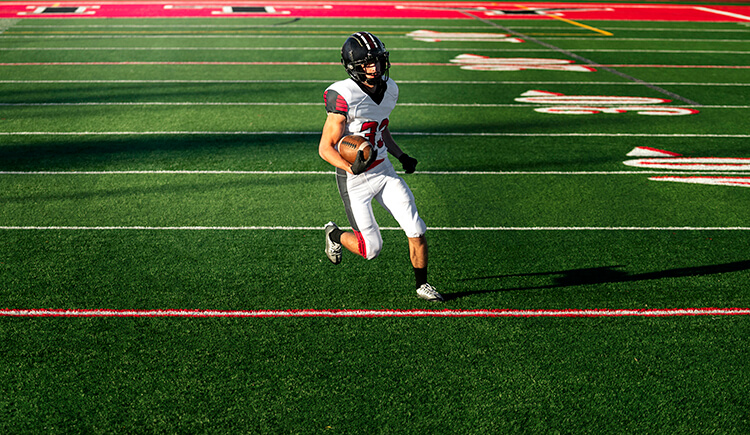
Case 1: Wembley Stadium, London - Advanced Multi Sport Turf Implementation
Retrofit Time: Summer 2022
Compatible Sports: Football + American Football (NFL London Games)
Technology Solution: "Double-Layer Adjustable Multi Sport Turf System"
Layer 1: Permanent Base Multi Sport Turf
- Grass height: 25mm blended monofilament (60% straight/40% curved)
- Infill: 18kg/m² custom blend
- Features: Meets daily football training needs
Layer 2: Event Overlay for Multi Sport Turf
- Installed 72 hours before NFL games
- 10mm specialized cushioning underlay
- 5mm surface texture layer (simulates natural grass)
- Removed within 48 hours post-game, restoring football mode
Economic Metrics:
- Overlay investment: £180,000
- Single NFL rental revenue: £750,000
- Payback period: <1 season
Case 2: Singapore National Stadium - Revolutionary Multi Sport Turf System
Feature: World's first "72-hour full conversion" venue using multi sport turf
Compatible Sports: Football, rugby, cricket, concerts
Core Technology: "Modular Multi Sport Turf Tray System"
Specifications:
- Individual tray size: 1.5m×1.5m
- Each includes: Fibers + infill + drainage + sensors
- Total quantity: 5,200 trays
- Conversion time: Football→Rugby 36 hours
- Conversion team: 15-person specialist team
Smart Features of Multi Sport Turf:
1. Independent monitoring of moisture, temperature, wear per tray
2. Real-time optimization via cloud management system
3. Robotic arm-assisted precision installation and retrieval
4. RFID tracking of each tray's usage history
Case 3: Melbourne Rectangular Stadium - Seasonal Adaptive Multi Sport Turf
Innovation: "Seasonal Adaptive" multi sport turf system
Design Philosophy: Automatic parameter adjustment based on event calendar
Winter Configuration (Rugby Season):
- Grass height increased to 28mm (natural growth adjustment)
- Rubber infill ratio increased to 85%
- Surface hardness: Gmax 120-130
- Drainage adjusted: 35mm/hour
Summer Configuration (Football Season):
- Grass height trimmed to 22mm
- Quartz sand ratio increased to 40%
- Surface hardness: Vertical deformation 7-9mm
- Drainage adjusted: 50mm/hour
Transition Processing for Multi Sport Turf:
- Each conversion requires 10-14 days
- Plant growth regulators control fiber characteristics
- Microbial additives adjust soil ecosystem
Compatibility Scoring System for Multi Sport Turf (Each item out of 10)
Test Field Case: Tokyo Multi-Sports Park
| Performance Metric | Football Mode | Rugby Mode | Hockey Mode | Compatibility Score |
| Ball Roll Consistency | 9.2 | 8.1 | 8.7 | 8.7 |
| Impact Absorption (Gmax) | 8.5 | 9.3 | 7.8 | 8.5 |
| Surface Evenness | 8.9 | 8.7 | 9.1 | 8.9 |
| Rotational Resistance | 8.7 | 9 | 8.3 | 8.7 |
| Durability Test | 8.4 | 8.1 | 7.9 | 8.1 |
| Conversion Convenience | - | - | - | 9.2 |
| Overall Score | 8.74 | 8.64 | 8.36 | 8.7 |
*Note: Scores based on International Sports Engineering Association 2023 standards*
Anonymous survey of 120 professional athletes:
- Performance retention vs. dedicated fields: 87% reported "almost no difference"
- Acceptance of multi sport turf compatibility mode: 92% considered "acceptable"
- Main concern: Infill layer stability in varying weather
- Impact protection rating: Average 8.3/10
- Surface traction: 0.4 points lower than dedicated fields
- Adaptation time during transition: Average 1.5 training sessions
- Ball speed consistency: 85% considered "good"
- Water distribution uniformity: Needs improvement
- Long-term wear: 25% faster than dedicated fields
Comparative Investment Model Analysis
| Item | Three Dedicated Fields | One Multi-Sport Grass Field | Savings/Increase |
| Land Occupation | 30,000m² | 10,000m² | 66.70% |
| Construction Cost | £4.5M | £2.8M | 37.80% |
| Annual Maintenance | £450,000 | £320,000 | 28.90% |
| Conversion Costs | None | £120,000/year | +£120,000 |
| Annual Usage Hours | 4,500 hours | 6,800 hours | 51% |
| 10-Year Total Cost | £9.0M | £6.0M | 33.30% |
| Return on Investment | 12.50% | 18.70% | 6.20% |
- Single field: Average 800 users weekly
- Multi sport turf field: Average 1,500 users weekly (+87.5%)
- Special beneficiaries: Schools, women's teams, disability sports
- Annual event types: Increased from 3 to 8
- Venue vacancy rate: Reduced from 45% to 22%
- Media exposure value: Increased average £150,000 annually
- Develops specialized maintenance teams
- Creates localized adaptation technologies
- Establishes industry standard influence
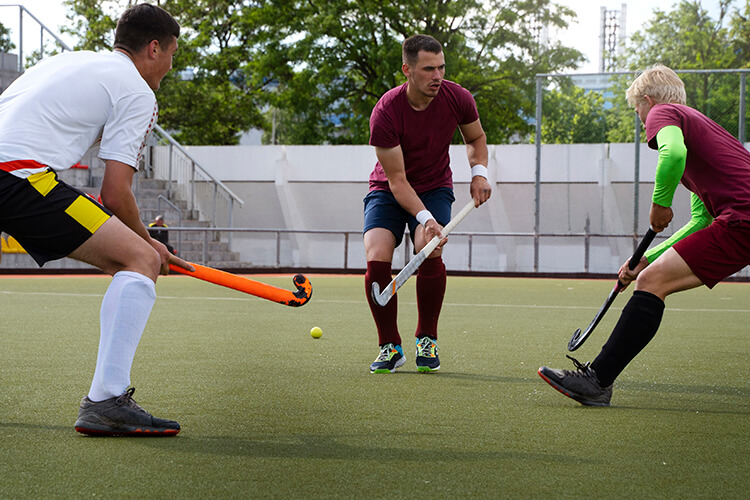
Establish a design committee including sports experts to determine:
- Frequency of each sport use (determines compatibility priority)
- Acceptable compromise ranges for performance requirements
- Budget and timeframes
Collaborate with manufacturers to develop:
1. Mixed denier fibers (varying thickness enhances durability)
2. Color zoning design (visual aids for different sport markings)
3. Reinforced tufting technology (improves tear resistance)
Establish localized testing lab:
- Simulate performance under different climatic conditions
- Test material degradation after long-term use
- Develop eco-friendly recyclable formulas
Deploy IoT systems:
- One sensor node per 200m²
- Real-time monitoring: Hardness, moisture, temperature, wear
- Predictive maintenance algorithms
Three-tier training system:
1. Basic maintenance personnel (daily upkeep)
2. Conversion specialists (mode switching)
3. System management engineers (overall optimization)
Develop detailed operation manuals:
- Football→Rugby conversion: 48-hour standardized process
- Rugby→Hockey conversion: 36-hour process
- Emergency conversion plan: 12-hour rapid protocol
Establish feedback loops:
- Quarterly athlete surveys
- Monthly performance data reviews
- Annual technology upgrade plans
Key Technological Breakthroughs:
1. Shape-Memory Fibers: Change cross-sectional shape via temperature or current
2. Magnetorheological Infill Layers: Real-time surface hardness adjustment via magnetic fields
3. Holographic Marking Systems: Laser-projected field markings for different sports
R&D Directions:
1. Gene-Edited Grass Varieties: Controllable adjustment of growth rate, height, hardness
2. Microbial Repair Systems: Biofilm technology for automatic fiber damage repair
3. Carbon-Capturing Turf: Special coatings to absorb atmospheric CO₂
Vision Characteristics:
- Automatic conversion without human intervention
- Personalized adjustment based on athlete biometrics
- Intelligent interaction with wearable devices
- Energy harvesting and self-powering systems

The design of multi sport turf fields is essentially a dialogue and negotiation between different sports cultures within the same physical space. This is not merely a technical issue but a philosophical one: How do we harmoniously coexist the elegance of football, the bravery of rugby, and the precision of hockey on a limited green space equipped with multi sport turf?
Modern sports infrastructure featuring multi sport turf is transitioning from "dedicated temples" to "public living rooms." Compatibility design in multi sport turf is not a result of compromise but a starting point for innovation—it requires us to view sports venues from a more systematic, intelligent, and humanistic perspective.
A successful multi sport turf field should possess this quality: Football players feel the rigor of a World Cup pitch when they step onto it; rugby players experience the passion of the Super Bowl during their charges; hockey athletes enjoy the precision of championship tournaments when they swing their sticks. And all this happens seamlessly through unnoticeable transitions enabled by advanced multi sport turf technology.
When we see children playing football today, rugby tomorrow, and learning hockey the day after on the same multi sport turf field, we witness not just increased venue utilization but the integration of sports spirit—the balance of competition and cooperation, the interplay of strength and skill, the harmony of individuals and teams.
Ultimately, the best multi sport turf fields make people forget the technology's presence. They become the background, the stage, the foundation that allows sports to shine. On this intelligent green surface, the boundaries between different sports will gradually blur, leaving only humanity's purest love for sport and that ever-ready, clever multi sport turf awaiting the next moment of passion.


