
WhatsApp

close
Choose Your Site
Global
Social Media
Author: Site Editor Publish Time: 2024-12-06 Origin: Site


Synthetic artificial grass has become a practical surface solution for sports facilities, school playgrounds, commercial landscapes, and residential outdoor spaces. However, choosing the right product involves more than comparing grass height, color, or price per square meter.
The composition of the grass fibers, backing structure, infill requirements, drainage performance, and ground preparation all affect installation costs and long-term maintenance.
For football field contractors, school procurement teams, landscape designers, and turf distributors, understanding these factors helps prevent costly specification mistakes. This guide explains how synthetic artificial grass is made, how infill and non-infill systems compare, and how to select the right outdoor synthetic grass for different applications.
Synthetic artificial grass is manufactured from polymer fibers attached to a backing system. Depending on the intended application, manufacturers adjust the fiber material, pile height, stitch density, yarn shape, backing construction, and drainage design.
A typical product consists of three main components.
Polyethylene (PE)
PE is widely used in landscape and sports turf because it offers a relatively soft feel, flexibility, and a natural-looking appearance. It is often selected for gardens, recreational areas, football fields, and other surfaces where comfort and appearance matter.
Polypropylene (PP)
PP fibers are generally firmer and can be useful in economical turf products, decorative applications, and selected sports surfaces. Their performance depends on the yarn design, construction, and intended use. PP is not automatically suitable for every sports application simply because it is firmer.
Nylon (polyamide)
Nylon offers good resilience and resistance to repeated deformation. It can be used in specialized sports and putting surfaces where fiber recovery and surface consistency are important. Its cost and feel differ from PE and PP, so the final selection should reflect the project requirements.
Some products combine different fiber materials to balance softness, resilience, appearance, and cost.
The backing holds the grass fibers in place and helps maintain the integrity of the turf during installation and use. Depending on the product, it may include a primary backing, a secondary coating, and drainage openings.
For outdoor synthetic grass, the backing should be selected according to expected traffic, installation conditions, and drainage requirements.
Before placing a bulk order, ask for confirmation of:
Primary and secondary backing materials.
Tuft bind or fiber retention performance, where relevant.
Drainage design and any available test data.
Compatibility with the proposed adhesive and installation method.
Suitability for the intended climate and application.
These details help buyers evaluate product quality beyond appearance alone.
Green synthetic grass is designed to maintain a consistent appearance without the mowing, watering, and fertilizing required by natural lawns. Outdoor products may incorporate UV stabilizers to help resist sunlight-related degradation.
However, color retention and service life depend on the yarn formulation, manufacturing quality, sunlight exposure, climate, installation, and maintenance. Buyers should request relevant technical information instead of assuming that every green turf product offers the same level of UV resistance.
Understanding the manufacturing process helps buyers assess product consistency and identify which specifications need to be customized.
Manufacturers select PE, PP, nylon, or a suitable combination according to the product's intended use. The polymer is processed into synthetic yarn with a specified color, thickness, and cross-sectional shape.
Different yarn profiles influence how fibers respond to foot traffic, how they recover after compression, and how natural the surface looks.
The yarn is processed and tufted into a backing material to create the grass surface. Pile height, stitch rate, and gauge affect the product's appearance, density, weight, and application suitability.
For example, a landscape lawn may prioritize a natural appearance and comfortable feel, while football turf requires a construction designed for repeated running, ball movement, and player interaction.
A suitable backing and coating system help secure the fibers and provide dimensional stability. The required construction depends on the intended application and the installation environment.
The finished turf is checked against the relevant product specifications. Depending on the product and quality-control plan, inspections may cover dimensions, appearance, backing condition, fiber retention, and other performance requirements.
For project orders, buyers should confirm the agreed specifications, inspection criteria, packaging method, and delivery schedule before production begins.
A synthetic grass manufacturer may be able to customize pile height, yarn profile, color combination, stitch density, backing, and roll dimensions.
For bulk orders, confirm that the selected specification is consistent across the production batch. Requesting a sample before final approval can help the project team evaluate the actual color, texture, and construction.
One of the most important purchasing decisions for sports projects is whether to choose an infill system or a non-infill system.
Both can be useful, but they are designed around different performance and maintenance priorities.
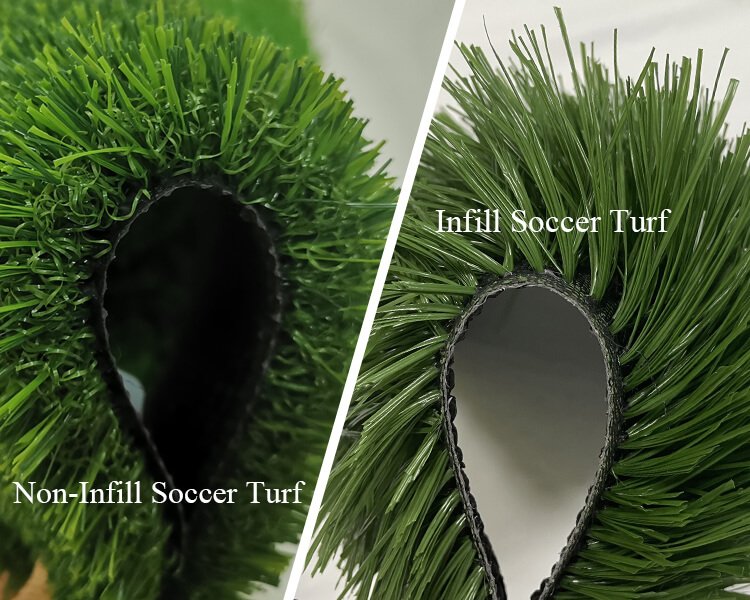
Infill synthetic grass uses loose material distributed between the fibers. Depending on the system, this may include silica sand, rubber granules, or other specified infill materials.
The infill helps support the fibers and contributes to the playing characteristics of the surface. In suitable systems, it can help provide the desired traction, cushioning, and ball response.
Advantages
Can provide playing characteristics suited to many football field designs.
Infill helps support the grass fibers when the system is correctly installed and maintained.
Different yarn constructions and infill specifications allow performance to be tailored to the intended sport.
Established installation and maintenance practices are available for many conventional infill systems.
Limitations
Installation requires the correct infill material and an even distribution.
Brushing and infill-level checks may be necessary to maintain consistent playing conditions.
Infill can migrate beyond the playing area or be carried away by footwear and maintenance equipment.
Infill replenishment, containment measures, and eventual waste management can increase lifecycle costs.
For example, 50 mm infill football turf system may require silica sand and rubber granules according to its specific design. The actual quantity and composition should be confirmed using the manufacturer's technical specification and project requirements rather than a generic rule.
Non-infill synthetic grass is designed to operate without loose sand or rubber granules. Its fiber geometry, pile construction, density, and backing are developed to provide the intended surface performance without a separate loose-infill layer.
Advantages
No routine loose-infill replenishment is required.
Reduces the risk of sand and rubber granules spreading beyond the field.
Simplifies some routine maintenance procedures.
Can be suitable for schools, community pitches, training areas, and recreational sports facilities when the product is correctly specified.
Limitations
Not every non-infill product is suitable for intensive competitive football.
Playing performance depends heavily on fiber construction, density, resilience, and installation quality.
A higher initial product price may apply to some designs.
Non-infill construction does not eliminate the need for brushing, cleaning, inspections, or eventual turf replacement.
Non-infill turf should therefore be evaluated against the required sport, expected usage, player comfort, and available performance data—not selected solely because it eliminates loose infill.
Comparison table for project buyers
Evaluation factor | Infill synthetic grass | Non-infill synthetic grass |
Loose infill | Required by the specified system | Not required |
Installation | Requires infill placement and leveling | No loose-infill installation |
Routine maintenance | May require infill redistribution and replenishment | No loose-infill replenishment, but brushing and cleaning remain necessary |
Material migration | Requires measures to control infill loss | Avoids loose sand and rubber infill migration |
Sports performance | Depends on the complete turf and infill system | Depends on fiber design and the complete turf system |
Lifecycle cost | Includes infill purchase, maintenance, and management | Includes cleaning, brushing, inspections, and replacement |
Best-fit applications | Sports systems designed and approved for infill | Suitable recreational and sports systems designed for non-infill use |
Choose infill football turf when the specified system's playing characteristics, technical requirements, and maintenance resources suit the project.
Consider non-infill football turf when reducing loose-material handling and simplifying routine field management are priorities, provided that the selected product meets the required playing-performance criteria.
For distributors and contractors, comparing the total installed and operating cost is more useful than comparing the grass price alone.
The most suitable outdoor synthetic grass depends on the location, user activity, drainage conditions, and maintenance plan.
Sports artificial grass is developed for applications such as football fields, training grounds, school sports areas, and selected tennis or multi-sport facilities.
The correct yarn profile, pile height, stitch density, backing construction, and surface system vary by sport. Football turf specifications should not automatically be applied to tennis, hockey, or other sports.
When evaluating sports turf, confirm:
The intended sport and expected usage intensity.
Required pile height and yarn construction.
Infill or non-infill system requirements.
Drainage performance and ground preparation.
Applicable sports-performance requirements and supporting test documentation.
Maintenance procedures and expected replacement considerations.
For large projects, confirm the entire surface system rather than assessing the grass carpet as an isolated product.
Landscaping synthetic grass is suitable for gardens, villas, parks, hotel grounds, commercial properties, rooftops, balconies, and selected indoor decorative areas.
PE or PE/PP blended fibers may be used to achieve a natural appearance, while different green shades and thatch colors can create a more realistic landscape effect.
Compared with natural grass, a suitable green synthetic grass installation can reduce routine mowing, watering, and fertilizing. It can also help maintain a consistent appearance in areas where natural grass is difficult to establish.
However, the sub-base and drainage design remain important. Poor preparation can cause water accumulation, uneven surfaces, or movement at the seams.
Colored synthetic grass can be used to create activity zones, play areas, decorative patterns, and recreational spaces at schools and kindergartens.
When selecting turf for children's areas, buyers should assess more than color and softness. Relevant considerations include the product's intended use, surface stability, drainage, fiber retention, applicable chemical documentation, and the requirements of any underlying impact-absorbing system.
Artificial grass alone should not be assumed to provide certified impact protection. Where fall-height requirements apply, specify and verify the complete playground surfacing system.
Pet areas benefit from a surface that is easy to clean and has suitable drainage. Buyers should consider how the installation will handle pet waste, washing, odor control, and frequent use.
The backing, sub-base, drainage route, and cleaning procedure should work together. A product described as pet-friendly does not automatically guarantee odor prevention or eliminate the need for regular cleaning.
The foundation influences surface stability, drainage, and long-term maintenance. Three common base approaches are asphalt, concrete, and compacted aggregate, although the right design depends on site conditions and the complete installation specification.
An asphalt base can provide a relatively stable, even surface for suitable sports installations. Its suitability depends on climate, structural design, workmanship, and drainage provisions.
In regions with large temperature variations, the design must account for the local freeze-thaw conditions and potential movement or cracking.
Concrete may be appropriate where a rigid, stable foundation is required, including some rooftop, balcony, and hardscape installations.
The surface must be sufficiently even, and the drainage design must prevent standing water. Cracks, joints, moisture conditions, and adhesive compatibility should be assessed before installation.
A properly designed aggregate base can provide effective drainage and may be economical for many landscape and sports projects.
Its performance depends on the aggregate grading, layer thickness, compaction, subgrade conditions, and finished slope. Poor compaction can lead to settlement and unevenness.
1. Hardness and stability: The base should provide adequate support for the intended use without unacceptable movement or settlement.
2. Flatness: The finished surface should meet the applicable project tolerances. Uneven areas can affect appearance, ball movement, drainage, and user comfort.
3. Drainage slope and capacity: Water must have a suitable route away from the surface. The design should consider rainfall intensity, soil conditions, the turf's drainage characteristics, and the capacity of the underlying drainage system.
Do not choose a foundation based on climate or price alone. Have the installation contractor assess the site, expected loads, local rainfall, and relevant sports or building requirements.
Required pile height and yarn construction.
For overseas projects, the purchase price is only one component of the total cost of ownership.
A lower-priced product may require more maintenance or earlier replacement if its specifications do not match the actual use conditions. Conversely, a higher-priced system is not automatically more economical unless its performance and service-life assumptions are supported by evidence.
Compare the following cost categories before selecting a supplier.
Cost category | Questions to ask |
Initial materials | What are the turf, infill, underlay, adhesive, and accessory costs? |
Ground preparation | Are excavation, grading, compaction, and drainage included? |
Installation | What are the labor, jointing, line marking, and equipment costs? |
Routine maintenance | How often are brushing, cleaning, inspections, and infill adjustments needed? |
Material loss | What measures are needed to control infill migration and replenish lost material? |
Repairs | Are seams, damaged areas, and localized drainage problems repairable? |
End of life | What are the removal, transportation, and disposal or recycling arrangements? |
Infill systems may incur additional costs for loose-material handling, containment, redistribution, and replenishment. Non-infill systems can reduce these particular expenses but still require maintenance and eventual replacement.
A meaningful comparison should use the same assessment period, project size, usage assumptions, and maintenance standards for both systems.
For projects supplied to European markets, environmental performance and regulatory documentation should be reviewed during product selection rather than after the order is placed.
Commission Regulation (EU) 2023/2055 amends REACH Annex XVII and introduces restrictions on synthetic polymer microparticles. For granular infill used on synthetic sports surfaces, the regulation establishes a transition period, with the relevant placing-on-the-market restriction scheduled to apply from 17 October 2031, subject to the regulation's scope and applicable provisions.
This is not a blanket ban on synthetic grass itself. Buyers planning European sports projects should assess the exact infill material, the product's intended use, the applicable regulatory scope, and the compliance requirements in force when the project is supplied. Refer to the official EU regulation on synthetic polymer microparticles for the legal text.
Practical environmental measures may include:
Evaluating non-infill turf where its playing performance is appropriate.
Selecting suitable infill containment and maintenance measures for systems that use loose infill.
Planning for the collection and management of displaced materials.
Requesting information about product composition and end-of-life handling.
Checking applicable test reports, declarations, and chemical documentation for the specific product.
CE, REACH, and other compliance documents should not be treated as interchangeable. CE marking applies only where the relevant legislation requires or permits it, and a REACH-related statement does not by itself establish that an entire sports field meets every environmental or safety requirement.
Before purchasing, ask the manufacturer to identify which certificates, declarations, and test reports apply to the exact product and intended application.
Correct installation and routine maintenance help protect the investment in synthetic artificial grass.
Prepare and compact the base according to the project specification.
Confirm the drainage route and finished slope.
Check roll dimensions, fiber direction, color consistency, and batch identification.
Use compatible seam tape, adhesive, and accessories where required.
Follow the specified infill type and application rate for infill systems.
Brush the turf as recommended for its construction and traffic level.
Remove leaves, litter, and other debris regularly.
Inspect seams, edges, drainage outlets, and high-traffic areas.
Redistribute or replenish infill when required by the maintenance plan.
Keep sharp objects, corrosive chemicals, and unsuitable cleaning products away from the surface.
Prevent unauthorized vehicles and concentrated heavy loads from damaging the turf or base.
Follow the manufacturer's footwear and equipment recommendations for the intended surface.
For football fields, use suitable sports footwear and follow the surface manufacturer's instructions. Avoid assuming that one footwear rule applies to every turf construction.
Ask the supplier for a product sample, a technical data sheet, available compliance documents, installation guidance, and written warranty terms.
For sports projects, also confirm whether the supplier can assist with grass specification, field-system selection, accessory planning, and installation guidance. These details can reduce misunderstandings between the manufacturer, installer, and project owner.

Working directly with a manufacturer can help project teams align product specifications, order quantities, and delivery schedules more efficiently.
XiHY Artificial Grass supplies synthetic grass products for sports and landscaping applications. Depending on the selected product and order requirements, buyers can discuss:
Customized pile heights, yarn profiles, colors, and construction parameters.
Product samples for initial evaluation.
Bulk-order production planning and delivery coordination.
Supporting documentation for the relevant product.
Guidance on turf selection, installation accessories, and project requirements.
Sports turf options for infill and non-infill football applications.
For European projects, request the specific CE-related documentation, REACH information, or test reports applicable to the product under consideration. Confirm lead time, warranty coverage, and installation support in writing before final approval.
If you are comparing turf for a football field, school playground, landscape project, or distribution program, provide the application, project area, location, expected traffic, and preferred specifications. This allows the supplier to recommend a more appropriate product rather than quoting an unsuitable grass carpet based on price alone.
A1: PE is widely used where a softer feel and natural appearance are priorities. PP is used in economical and selected decorative or sports applications, while nylon may suit specialized surfaces requiring resilience. The best material depends on the intended use and the complete turf construction.
A2: Neither is universally better. Infill systems can meet the performance needs of many football field designs but require infill installation and maintenance. Non-infill systems eliminate loose infill but must still meet the project's playing-performance requirements.
A3: Service life depends on product quality, UV exposure, traffic, installation, climate, and maintenance. Ask the supplier for the product-specific warranty and expected service-life assumptions. A warranty period should not be treated as a guaranteed replacement date or a universal lifespan.
A4: Yes. Outdoor installations need a drainage design suited to local rainfall, the base, and the turf construction. Drainage holes in the backing cannot compensate for a poorly prepared or inadequately drained foundation.
A5: Choose a system appropriate for the level of play, prepare the base correctly, and establish a regular inspection and maintenance plan. For infill fields, include infill redistribution, loss control, and replenishment in the operating budget. Non-infill systems avoid those particular tasks but still require brushing, cleaning, and repairs when necessary.
A6: Request a sample, technical data sheet, product-specific compliance documentation, recommended installation method, maintenance instructions, warranty terms, and a quotation based on the agreed specifications. For sports projects, also confirm performance requirements and the suitability of the complete field system.
Synthetic artificial grass can provide a practical alternative to natural grass for sports facilities, schools, commercial landscapes, and residential outdoor spaces. However, product performance depends on the relationship between fiber material, backing, drainage, foundation, and maintenance.
Infill turf can be suitable where the specified sports system requires its playing characteristics and the operator can manage loose infill responsibly. Non-infill turf may simplify maintenance where its construction meets the intended performance requirements. Landscaping turf follows a different set of priorities, with appearance, drainage, durability, and ease of care playing central roles.
Before ordering, compare the technical specifications, installed cost, maintenance requirements, environmental considerations, and written warranty. Contact XiHY to discuss samples, customized turf specifications, and product options for your next sports or landscaping project.


