
WhatsApp

close
Choose Your Site
Global
Social Media
Author: Site Editor Publish Time: 2025-08-20 Origin: Site


How Much Does an Artificial Turf Soccer Field Cost?
Planning a new synthetic turf field for a school, sports club, municipality, or commercial facility? One of the first questions is usually straightforward: how much does an artificial turf soccer field cost?
For a full-size soccer field, the total project budget can commonly fall within $280,000–$530,000, while smaller 5-a-side and 7-a-side fields can require significantly less investment. However, the turf itself is only one part of the budget.
For contractors, stadium operators, schools, and turf distributors, the more useful question is:
What makes up the total cost, and which choices will reduce lifecycle expenses without compromising field performance?
This guide breaks down the major cost factors, compares infill and non-infill soccer grass, and explains what buyers should evaluate when sourcing soccer field artificial grass from overseas suppliers.
Before requesting quotations, it helps to establish a realistic budget range.
| Field Type | Approx. Playing Area | Typical Project Budget* |
|---|---|---|
| 5-a-side field | ~375 m² | $15,000–$28,000 |
| 7-a-side field | ~1,500 m² | $60,000–$110,000 |
| Full-size soccer field | ~7,140 m² | $280,000–$530,000 |
Actual project costs vary according to country, site conditions, turf specification, drainage, base construction, installation method, equipment, and local labor rates.
These figures should therefore be treated as planning ranges rather than fixed quotations.
For B2B buyers, obtaining a reliable project quotation requires more than asking for a price per square meter. A supplier should understand the field dimensions, intended use, turf system, sub-base condition, drainage requirements, and expected playing frequency before calculating the complete material package.
The final budget is usually divided into several major components.
The turf system is one of the most visible cost differences between projects.
Pricing can change according to:
Pile height
Yarn material and shape
Yarn weight and durability
Turf density
Backing construction
UV stabilization
Infill requirements
Shock-pad requirements
Drainage performance
Expected playing intensity
A professional training center operating several hours every day may require a more durable specification than a school field used primarily for physical education.
This is why purchasing the cheapest soccer field artificial grass can sometimes create higher replacement and maintenance costs later.
The right approach is to specify the turf according to usage intensity and expected service life, rather than simply selecting the lowest price per square meter.
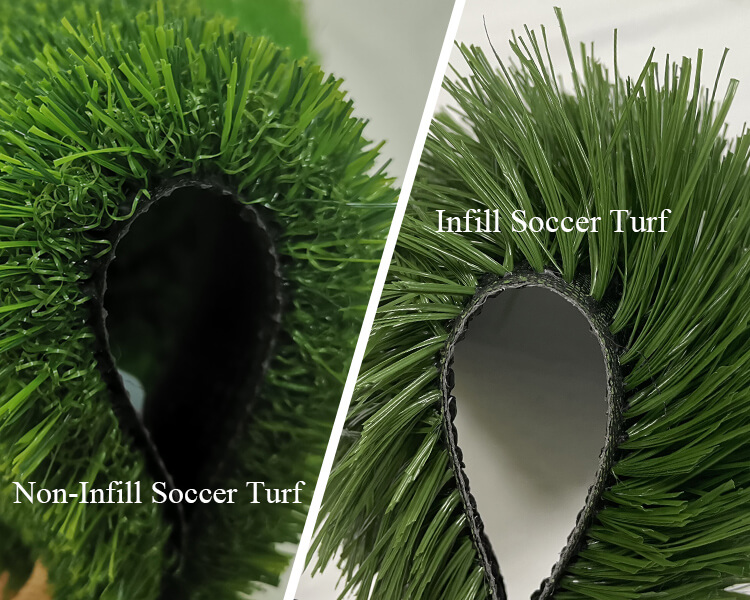
Infill vs. Non-Infill Soccer Turf: Which Is More Cost-Effective?
One of the most important purchasing decisions is whether to use an infilled artificial turf system or non-infill soccer grass.
Infilled Soccer Turf
Traditional 3G soccer systems generally use sand and performance infill, such as rubber or alternative granules.
Advantages:
Established solution for high-level soccer applications
Good player-surface interaction
Infill contributes to fiber support
Can provide suitable shock absorption when properly engineered
Widely understood by installers and field operators
Potential disadvantages:
Higher installation complexity
Requires regular infill redistribution and top-ups
Infill can migrate outside the field
Loose particles may create cleaning and dust-management issues
End-of-life disposal can involve additional material handling
More maintenance operations are required over the field lifecycle
For facilities with established maintenance teams and suitable equipment, an infilled system can remain a practical choice.
Non-infill soccer grass eliminates the traditional loose infill layer and uses turf construction designed to maintain performance without conventional granular infill.
Advantages:
Less dependence on loose infill materials
Simpler routine maintenance
No regular rubber or sand top-up in the conventional sense
Reduced infill migration
Easier field cleaning
Potentially lower maintenance complexity over time
Potential considerations:
The initial turf specification may cost more than basic turf
Not every non-infill system is suitable for every competitive application
Performance depends heavily on yarn design, density, backing, and system construction
The sub-base and shock-absorption design still need to be correctly engineered
For schools, training facilities, recreational fields, and projects where maintenance simplicity and long-term operating costs are important, a non-infill system can be worth evaluating.
Which System Should You Choose?
There is no universal answer.
| Consideration | Infill Soccer Turf | Non-Infill Soccer Grass |
|---|---|---|
| Initial turf cost | Often lower | Can be higher |
| Loose infill required | Yes | No conventional loose infill |
| Routine infill management | Required | Significantly reduced |
| Maintenance complexity | Higher | Lower |
| Infill migration | Possible | Eliminated/reduced |
| Cleaning requirements | More involved | Generally simpler |
| Suitable applications | Competitive, training, multi-use | Schools, training, recreational, selected professional applications |
| Lifecycle planning | Requires infill management | Focuses more on turf/system durability |
The best choice depends on field usage, performance requirements, maintenance resources, local regulations, and total cost of ownership.
Turf cannot compensate for a poorly prepared foundation.
Groundwork can represent a substantial portion of the overall artificial turf soccer field cost, particularly when the existing site requires excavation, leveling, soil replacement, aggregate construction, or drainage improvements.
Typical work may include:
Site excavation
Soil stabilization
Sub-base construction
Aggregate installation
Leveling and compaction
Perimeter drainage
Surface drainage
Underground drainage systems
Shock-pad installation where required
For overseas projects, this is particularly important because soil conditions vary significantly between regions.
A field in an area with heavy rainfall may require a different drainage strategy from a project in a dry climate.
Do not compare turf quotations without checking whether the suppliers are quoting the same scope of work.
A low turf price can become an expensive project if the foundation or drainage system has been underestimated.
Professional installation affects both the initial budget and the future performance of the field.
Installation normally involves:
Preparing and inspecting the base.
Positioning turf rolls.
Cutting and aligning the panels.
Joining seams.
Installing field markings.
Completing the required infill or system components.
Brushing and finishing the surface.
Inspecting drainage and overall surface performance.
Labor rates vary considerably between countries.
For contractors importing turf from overseas, one practical strategy is to source the turf and technical system from an experienced manufacturer while using qualified local installation teams.
A manufacturer that can provide installation drawings, laying guidance, seam recommendations, and technical support can help reduce avoidable installation errors.
The purchase price is only the beginning of the investment.
A synthetic turf field typically requires:
Routine brushing
Surface cleaning
Debris removal
Seam inspection
Infill management for infilled systems
Periodic deep cleaning
Drainage inspection
Minor repairs
A frequently used field may require substantially more maintenance than a school field with limited weekly usage.
A planning estimate of $5,000–$15,000 per year is sometimes used for routine maintenance, but actual costs vary by field size, climate, usage, equipment, labor, and turf system.
The expected replacement cycle is also important. A well-maintained field may commonly require resurfacing after approximately 8–12 years, although actual service life depends on traffic, maintenance, UV exposure, installation quality, and product specification.
This is why B2B buyers should evaluate total cost of ownership (TCO) instead of focusing only on the initial turf quotation.
For European projects and environmentally conscious buyers, field sustainability is becoming an increasingly important procurement factor.
Traditional infilled systems may create additional considerations around:
Infill migration
Particle containment
Cleaning
Material replacement
End-of-life separation
Waste transportation
Disposal of used turf and infill
Where applicable, buyers should request documentation covering material composition and relevant environmental compliance.
For projects targeting the European market, CE and REACH-related documentation, together with appropriate product testing and material declarations, can help contractors and importers evaluate supplier compliance and reduce procurement uncertainty.
The exact compliance requirements depend on the intended application and local regulations, so buyers should verify which documents are required for their specific project.
Reducing the budget does not necessarily mean choosing cheaper turf.
Instead, focus on the largest cost drivers.
A recreational school field does not necessarily need the same specification as a professional training center.
Define:
Expected playing hours
Number of users
Competition level
Climate
Maintenance capacity
Expected service life
Then select the appropriate turf system.
When comparing wholesale artificial turf suppliers, request a complete quotation covering the same specification.
Ask suppliers to clarify:
Turf price per m²
Required quantity
Yarn specification
Pile height
Density
Backing
Infill requirements
Shock pad
Accessories
Packaging
Shipping terms
Technical support
This makes supplier comparisons much more meaningful.
A turf system that costs slightly more initially may be more economical if it reduces:
Infill consumption
Cleaning frequency
Repair requirements
Labor input
Replacement frequency
For high-use facilities, even small annual savings can become significant over the field's service life.
Before placing a bulk order, contractors and importers should ask suppliers for more than a product catalog.
A reliable manufacturer should be able to provide clear information about:
Yarn material and construction
Pile height and density
Backing system
UV resistance
Drainage performance
Recommended applications
Available certifications and test reports
Sample availability
Warranty terms
Production capacity
Lead time
Container loading information
Installation recommendations
For large projects, it is also useful to request a physical turf sample before confirming the bulk order.
This allows the project team to evaluate the yarn appearance, softness, resilience, backing quality, color combination, and overall construction.
For contractors and distributors purchasing large quantities, buying directly from an artificial turf manufacturer can provide advantages beyond the factory price.
A source manufacturer can coordinate turf specifications, production schedules, packaging, samples, and technical documentation through one supply chain.
For example, an experienced factory may support:
Custom yarn parameters
Customized pile height and density
Project-specific turf construction
Free samples for evaluation
Large-volume production
Faster bulk delivery
Long-term warranty options
Installation and laying guidance
Complete soccer field material solutions
This is particularly useful when a contractor is managing multiple fields or when a distributor needs a consistent product specification across different projects.
For European buyers, available CE/REACH-related environmental documentation can also make supplier evaluation more straightforward, subject to the requirements of the specific product and application.
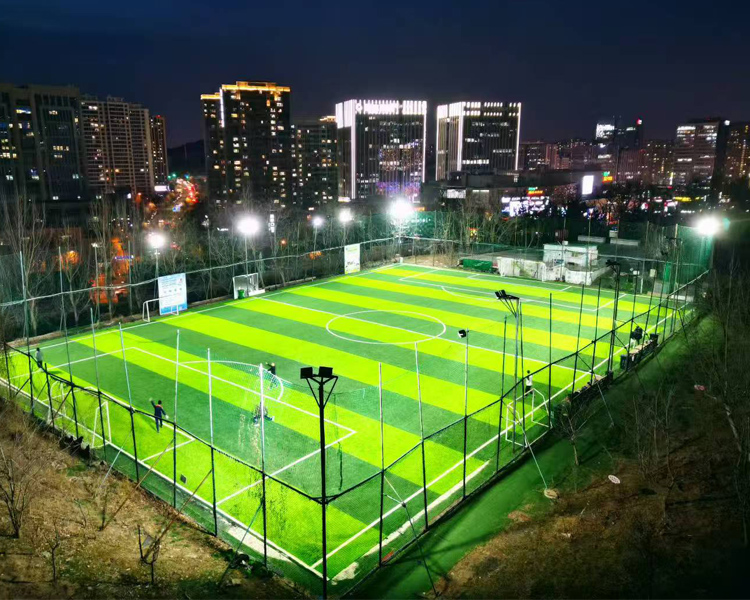
Before requesting a final quotation, prepare the following information:
Field size: length × width
Number of fields: single or multiple
Application: professional, training, school, recreational
Expected playing hours: low, medium, or high
Preferred turf system: infill or non-infill
Pile height: based on application
Climate: hot, cold, wet, or high UV
Existing foundation: new construction or renovation
Drainage condition: existing or new
Installation scope: material supply only or complete project support
Target delivery date: required production and shipping schedule
Required certifications: according to destination market
The more complete the project information, the more accurate the supplier's quotation will be.
The cost of an artificial turf soccer field is not determined by the turf price alone.
For a complete project, buyers need to consider:
Turf + groundwork + drainage + installation + maintenance + replacement + end-of-life costs.
A low initial quotation may not be the lowest-cost solution over 8–12 years.
For schools, sports operators, contractors, municipalities, and turf distributors, the better purchasing strategy is to compare performance, maintenance requirements, product compliance, supplier reliability, and lifecycle cost together.
If you are planning a new synthetic turf field or sourcing soccer field artificial grass in bulk, providing the field dimensions and intended application allows a manufacturer to recommend the appropriate turf system and prepare a project-specific quotation.
Request a turf sample, discuss your field specifications, and compare the complete system cost before placing your bulk order.


