
WhatsApp

close
Choose Your Site
Global
Social Media
Author: Site Editor Publish Time: 2025-03-11 Origin: Site


Football Synthetic Turf: No-Infill vs Infill for Soccer Fields
Choosing the right football synthetic turf is not simply a matter of comparing pile height, color, or price per square meter.
For a school, sports facility, football field contractor, or turf distributor, the more important question is:
Should the project use a no-infill system or an infill system?
Both systems can be used for an artificial turf football field, but they are built around different maintenance strategies and performance characteristics.
An infill system uses materials such as silica sand and rubber or other granules between the synthetic fibers. A no-infill system is designed without loose infill and relies more heavily on the yarn structure, density, backing and overall field system to provide stability and playing characteristics.
The right choice depends on the project's usage intensity, climate, maintenance resources, installation specification, budget and long-term operating plan.
This guide compares the two systems from a practical procurement perspective so you can evaluate which football synthetic turf solution is more suitable for your next soccer project.
| Factor | No-Infill Football Turf | Infill Football Turf |
|---|---|---|
| Loose infill | Not required | Required |
| Routine infill top-up | Not required | Required |
| Maintenance workload | Generally simpler | Requires regular brushing and infill management |
| Fiber support | Mainly provided by turf construction | Supported by infill and turf construction |
| Cushioning | Depends on turf system and shockpad | Infill contributes to system cushioning |
| Infill migration | Eliminated as a loose-infill issue | Requires management |
| Installation | Simpler infill stage | Additional infill installation required |
| Initial material cost | Depends on turf specification | Includes turf plus infill materials |
| Long-term maintenance | Potentially lower | Usually includes ongoing infill maintenance |
| Best suited to | Projects prioritizing simplified maintenance | Projects requiring established infill-based field systems |
The table is a starting point, not a universal winner. A properly specified soccer grass field needs to be evaluated as a complete system rather than by the carpet alone.
No-infill football synthetic turf is an artificial grass system designed to operate without loose sand or rubber granules distributed throughout the carpet.
Instead, the playing characteristics depend on the construction of the turf itself, including:
Yarn shape and structure
Fiber density
Pile height
Backing construction
Tufting quality
Drainage design
Shockpad or elastic layer where required
Sub-base and installation quality
For example, XiHY's outdoor non-infill soccer turf uses UV-resistant synthetic fibers and a durable backing system. The product can be customized in areas such as pile height, yarn shape, density, color, backing construction and drainage performance.
This makes no-infill turf attractive for projects where operators want to reduce the amount of loose material that has to be distributed, redistributed and replenished during the field's service life.
However, no-infill does not mean no maintenance.
The field still needs periodic brushing, cleaning, seam inspection and general surface maintenance. The advantage is that maintenance does not include routine management of loose infill.
The infill football synthetic turf system contains loose material between the grass fibers.
Depending on the system specification, this can include silica sand, rubber granules or other approved infill materials.
The infill serves several important functions:
Helps support synthetic fibers
Contributes to surface stability
Provides cushioning
Influences player traction
Affects ball response
Helps maintain the designed playing characteristics
XiHY's infill football turf range includes PE and PP fibers, customizable pile heights and densities, drainage backing and options for different football field applications.
For many contractors and facility operators, the biggest advantage of an infill system is that its performance characteristics are familiar and well established across a wide range of football installations.
The trade-off is that the infill becomes another material that has to be installed, maintained and managed throughout the field's lifecycle.
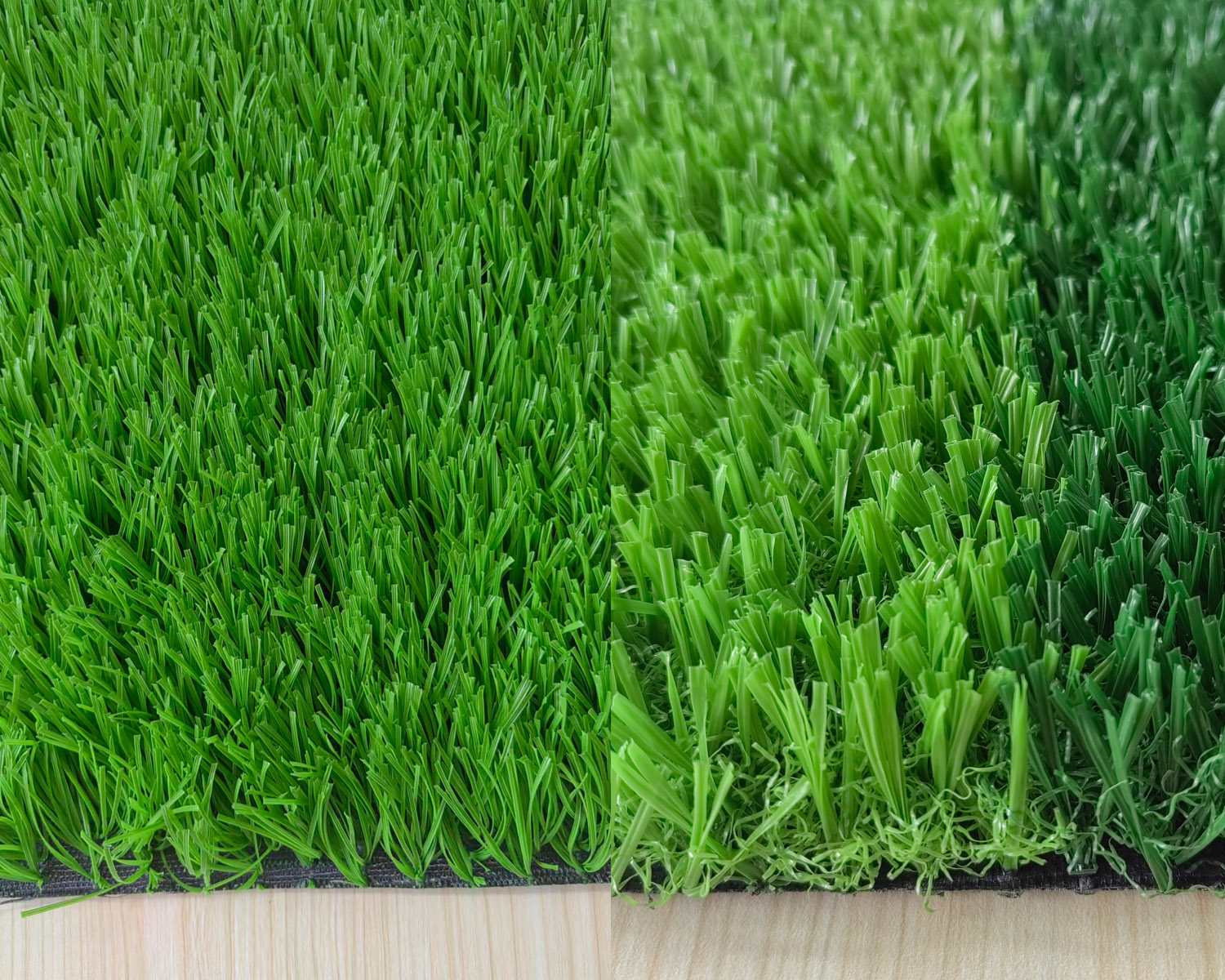
There is no universal answer.
The performance of a football synthetic turf system depends on the complete field construction, not simply whether it contains infill.
Important performance factors include:
Player comfort depends on the complete surface system.
An infill system can use loose material as part of its cushioning and stability structure. A no-infill system may rely more heavily on the turf construction and, where specified, an elastic shockpad.
For projects with strict performance requirements, the contractor should evaluate the complete system rather than comparing the carpet alone.
The interaction between the football and the surface is affected by:
Fiber height
Fiber density
Yarn geometry
Surface firmness
Infill level
Underlying shock absorption
Installation quality
For this reason, a higher-priced turf is not automatically a better solution for every soccer grass field.
The turf should be matched to the intended level of play and field specification.
An infill system requires the infill depth to remain reasonably consistent across the field.
Heavy use can gradually redistribute loose materials, particularly around high-traffic areas.
A no-infill system removes this particular management issue, but its surface performance still depends heavily on correct installation and the condition of the turf system underneath.
For facility operators, maintenance can be more important than the initial turf quotation.
The infill football synthetic turf field typically requires:
Regular brushing
Inspection of high-use areas
Infill redistribution
Infill replenishment
Surface cleaning
Seam inspection
Drainage inspection
If infill levels become uneven, the playing characteristics of the field can change.
This means facility operators need a maintenance schedule and suitable equipment rather than treating the artificial grass as a maintenance-free surface.
No-infill systems remove the need to replenish loose infill.
Routine maintenance can therefore focus on:
Brushing
Cleaning
Removing debris
Checking seams
Inspecting drainage
Monitoring high-traffic areas
This can be particularly useful for schools, training facilities and community pitches where maintenance staff or equipment availability is limited.
Important: No-infill does not mean zero maintenance. It means a different maintenance model.
Comparing only the purchase price per square meter can produce the wrong conclusion.
For an artificial turf football field, project cost should be evaluated across several stages:
Turf + installation + infill + maintenance + replacement materials + end-of-life handling
An infill field requires additional materials and installation work because the infill must be distributed and properly integrated into the turf system.
A no-infill system removes this additional infill stage.
However, the final project price depends on the specification of the turf, shockpad, sub-base, drainage, installation method and project size.
Therefore, it is not accurate to assume that every no-infill field will have a lower initial price.
This is where the systems can differ significantly.
An infill field may require additional labor and materials for brushing, redistribution and replenishment.
A no-infill field eliminates routine infill top-up, which can simplify maintenance planning.
For a high-use soccer grass field, buyers should ask suppliers for a lifecycle cost estimate, not only a product quotation.
Environmental performance is becoming an increasingly important part of artificial turf procurement, particularly for projects entering European markets.
One important distinction should be made:
CE and REACH are not the same type of certification.
CE relates to applicable EU product conformity requirements, while REACH addresses chemical substances and their safe use within the EU regulatory framework. Buyers should request the specific compliance documentation applicable to the product and intended market.
For an artificial turf project, environmental assessment should also consider what happens to the system after years of use.
The infill football field contains a large quantity of loose material.
During the field's service life, some infill may need to be redistributed or replenished. At the end of the field's life, the turf and infill also need to be separated, removed and handled.
This creates additional:
Material handling
Transportation
Labor
Disposal planning
Site-cleaning requirements
Infill migration can also become an operational issue when loose material moves outside the intended playing area.
The no-infill system eliminates the loose-infill component from the field.
This does not automatically make the entire field recyclable, because the turf system may still contain different polymers, backing materials, adhesives and other components.
However, removing loose infill can simplify part of the removal and material-handling process.
For buyers planning projects in markets with increasing emphasis on product stewardship, it is worth asking the manufacturer:
What materials are used in the turf?
What environmental documentation is available?
Can the turf be separated at end of life?
What recycling options are available?
How should the used turf be handled?
What documentation can be provided for the target market?
These questions are more useful than simply asking whether a product is "eco-friendly."
A no-infill football synthetic turf system may be worth considering when the project prioritizes:
Schools and community facilities may benefit from avoiding routine infill replenishment.
Without loose sand or rubber granules, there is less loose material to migrate outside the playing area.
There is no need to store, transport and periodically distribute replacement infill.
For operators managing several fields, reducing maintenance tasks can make scheduling and labor planning easier.
Where loose infill management and end-of-life handling are major concerns, a no-infill design may offer a simpler system architecture.
An infill system can still be a practical choice for many projects.
Consider an infill football synthetic turf system when:
The project specification is designed around an infill-based system.
Cushioning characteristics require an infill component.
The contractor has established infill installation and maintenance procedures.
The facility has suitable maintenance equipment.
The project requires a familiar, widely used field construction method.
The budget and lifecycle plan allow for ongoing infill management.
The key is not to select a system simply because it is marketed as newer or cheaper.
The field specification should come first.
Before requesting a quotation, prepare the following information.
Provide the field dimensions and required roll layout.
Tell the supplier approximately how many hours per week the field will be used.
A school training pitch and a professional football facility may require very different turf constructions.
Consider:
UV exposure
Rainfall
Temperature
Drainage conditions
Seasonal weather
Outdoor turf should be selected with local climate conditions in mind.
Define whether the field is intended for:
Training
School sports
Community football
Professional use
Competition
Multi-purpose recreation
Ask a simple operational question:
Who will maintain the field after installation?
If maintenance resources are limited, the difference between an infill and no-infill system becomes more important.
For overseas projects, confirm the environmental and product compliance documentation required in the destination market.
For European projects, buyers should discuss applicable CE, REACH and other documentation requirements with the supplier rather than relying on a generic certification statement.
A reliable supplier should be able to discuss more than price.
Before placing a bulk order, ask for:
Turf specification sheet
Yarn material and structure
Pile height
Stitch density
Backing construction
Drainage design
UV-resistance information
Recommended installation system
Maintenance requirements
Warranty terms
Environmental/compliance documentation
Sample availability
Production lead time
Packaging and shipping options
XiHY manufactures artificial turf in China and supports customization of parameters such as color, texture, size, quality, packaging and labeling. Its production process includes fiber production, tufting, backing, finishing and inspection, which allows project specifications to be discussed directly with the manufacturer.
Standard football turf samples are also available, with customized samples handled according to the product and project requirements. Current product information lists typical lead times of around 7–25 days depending on customization.
For overseas contractors and distributors, this direct communication can be useful when the project requires a specific yarn structure, pile height, density, drainage configuration or repeat-order specification.
Before choosing your football synthetic turf, compare both systems against these questions:
| Question | No-Infill | Infill |
|---|---|---|
| Do you want to avoid loose infill? | ✓ | — |
| Is simplified maintenance important? | ✓ | — |
| Does the project already specify infill? | — | ✓ |
| Do you have regular maintenance resources? | Less dependent on infill management | More important |
| Is infill-based cushioning part of the specification? | Depends on system | ✓ |
| Are end-of-life material handling requirements important? | Simpler loose-material management | Requires infill handling |
| Does the project need a customized system? | ✓ | ✓ |
| Is the lowest initial purchase price the only priority? | Compare quotations | Compare quotations |
The most important point is that neither no-infill nor infill football turf is automatically right for every project.
A good selection should balance playing performance, installation requirements, maintenance capacity, climate, budget and end-of-life planning.
For a new artificial turf football field, the best procurement approach is to compare the complete field system rather than comparing turf prices alone.
If you are planning a school field, training ground, community pitch, stadium or commercial soccer project, provide the field dimensions, intended usage, country and preferred turf system. A manufacturer can then recommend the appropriate turf construction, backing, drainage and installation configuration before bulk production.
For projects requiring custom soccer grass field specifications, samples can also be evaluated before confirming the final order.


