
WhatsApp

close
Choose Your Site
Global
Social Media
Author: Site Editor Publish Time: 2026-06-12 Origin: Site


Selecting golf turf represents a high-stakes investment for any facility or homeowner. A fraction of an inch in pile height dictates your final result. You either create a surface mimicking a pristine country club or completely ruin the user experience. You simply cannot afford to guess on this crucial dimension.
Many buyers view pile height as a purely aesthetic choice. However, it serves as the foundational metric governing surface performance. It dictates ball roll speed, clubhead interaction, and long-term durability. We must look at the math and physics behind these synthetic fibers. Evaluating them properly ensures your installation performs as intended.
This article provides a technical, vendor-neutral framework for evaluating golf turf pile height. We will break down exactly how to match specifications to your application requirements. Whether you are building an indoor striking mat or an outdoor putting green, you will learn how to choose the optimal setup.
Function Dictates Height: Putting greens require a short, tightly woven pile (typically 0.5” to 0.625”) for true roll, while hitting mats need taller fibers (1” to 1.25”) to absorb club shock and prevent wrist injury.
Density Multiplies Height: Pile height cannot be evaluated in isolation; face weight and density determine whether a taller turf will support a ball properly or flatten under pressure.
Environment Changes Specs: Backyard installations require infill accommodation and drainage integration, effectively altering the "playable" height compared to glued-down indoor simulator turf.
Customization is Key: Commercial facilities and serious players often require custom pile height artificial grass to dial in specific Stimpmeter speeds.
You must establish a clear technical baseline before making material decisions. Pile height specifically measures the length of the turf fiber. We measure it from the primary backing up to the very tip of the yarn. Manufacturers list this dimension in inches or millimeters. Do not confuse it with face weight. Face weight measures the total ounces of fiber per square yard. Pile height measures length, while face weight measures mass.
Friction equations dictate your ball roll on synthetic surfaces. Longer fibers increase physical drag. They actively slow down the golf ball. Shorter fibers reduce drag and create a faster roll. A precise, short pile mimics tightly mowed Bentgrass found on championship courses. You manipulate the Stimpmeter reading directly by altering the fiber length.
Biomechanics also play a massive role during a golf swing. When iron strikes the ground, the clubhead must glide. Using standard sports grass without the correct height-to-density ratio causes severe deceleration. The clubhead digs in or bounces abruptly. This destroys your swing mechanics and risks physical injury. The surface must allow the club to pass through seamlessly.
Infill introduces a critical variable into this equation. Total pile height differs greatly from exposed pile height. Once installers add silica sand or acrylic infill, the playable fiber length shrinks. The infill buries the lower section of the yarn. You must calculate your desired exposed height after accounting for the infill volume.
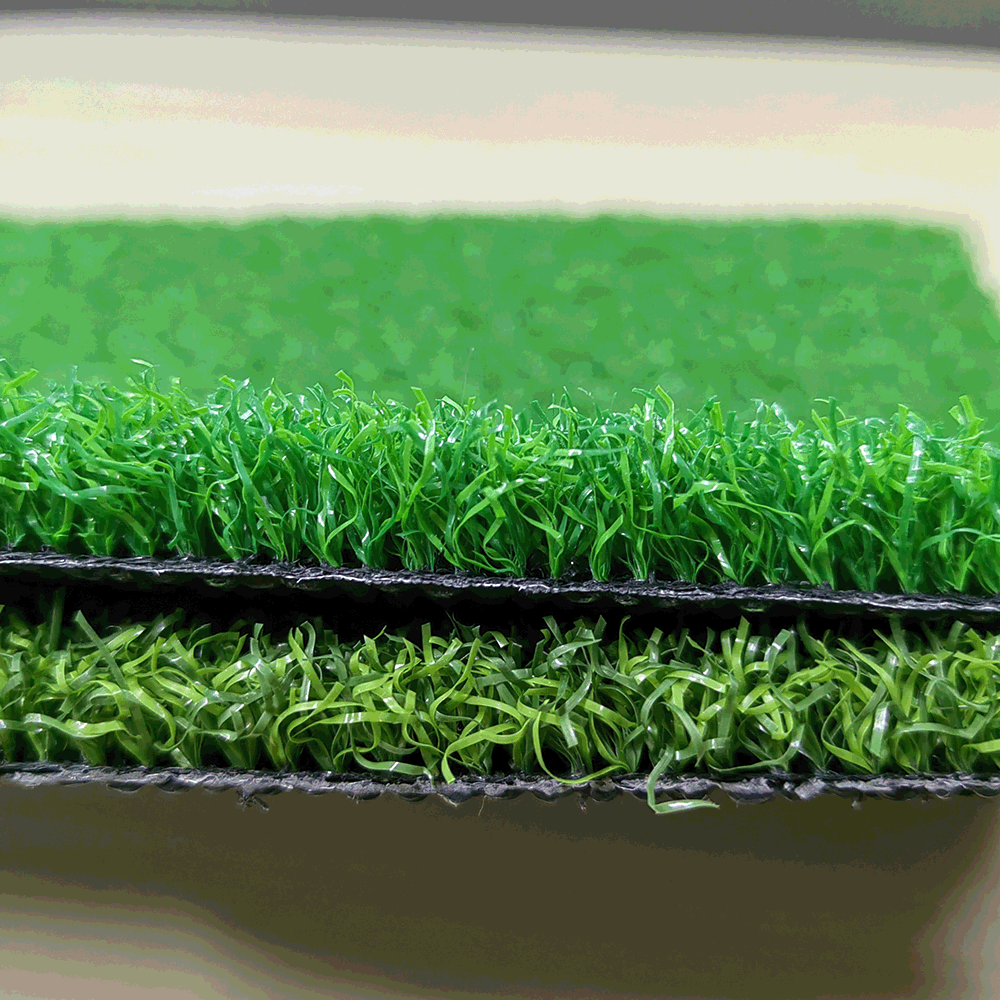
A true putting surface demands exact specifications. The recommended pile height ranges from 0.50 inches to 0.625 inches (12mm to 16mm). This narrow window provides the optimal balance of speed and control. Professional designers rarely deviate from these numbers for standard applications.
This specific height maximizes ball speed. It allows for true, predictable breaks across the surface. A 0.50-inch pile offers minimal resistance, yielding faster Stimp readings. You can practice delicate putts with absolute confidence. Selecting a premium golf putting green turf guarantees realistic feedback.
However, shorter piles carry a distinct risk factor. They are entirely unforgiving of sub-base imperfections. Every minor dip or bump translates directly to the surface. A perfectly leveled base is absolutely mandatory. Without it, you will experience severe tracking anomalies.
Common Mistakes in Putting Green Construction:
Failing to compact the aggregate base to 90% or higher.
Choosing a pile shorter than 0.50 inches outdoors, limiting sand capacity.
Ignoring the natural break and slope during grading.
Hitting mats require entirely different engineering. You need a much taller surface to absorb impact safely. The recommended range falls between 1.0 inch and 1.25 inches (25mm to 32mm). This height accommodates full swings with heavy irons.
This taller profile yields excellent performance outcomes. It allows players to insert real wooden tees directly into the fibers. The clubhead can pass cleanly through the material. It accurately simulates taking a real turf divot. Golfers experience realistic feedback without jarring their wrists upon impact.
You must watch out for the density risk factor here. If the pile is tall but density remains low, the ball sinks. It sits in a small depression before you strike it. This inevitably leads to "fat" shots. High density is non-negotiable to support the ball's weight at taller heights.
Indoor golf setups face unique installation realities. Installers usually glue the material directly to a concrete floor. Sometimes they use an interlocking shock pad system. These controlled environments shield the surface from weather extremes. You do not worry about heavy rain, freezing temperatures, or intense UV degradation.
Height considerations shift significantly indoors. You can safely utilize shorter, high-density non-infill options. Nylon blends dominate this category. Since you omit weather resistance and water drainage, the fibers do not need deep infill to stay upright. This simplifies the maintenance routine considerably.
Your evaluation criteria must adapt to these indoor constraints. Focus entirely on fiber memory and impact resistance. The surface will endure repetitive, concentrated impacts in the exact same spot.
Indoor Simulator Evaluation Checklist:
Verify the melt point of the fibers against high-speed ball friction.
Test the shock pad thickness to prevent concrete bounce-back.
Confirm the backing material bonds well with standard adhesives.
Outdoor applications present harsh environmental realities. Installers lay the turf over a crushed aggregate sub-base. The material faces constant exposure to harsh UV rays and heavy rain. It must handle fluctuating temperatures without shrinking or expanding aggressively.
Height considerations must accommodate these outdoor demands. Installers often require slightly taller pile heights, typically 0.625 inches or more for putting areas. You need this extra length to hold heavier sand infill. The infill provides vital ballast weight. It prevents the turf from wrinkling in the sun and allows the green to hold incoming approach shots.
Integration into the surrounding landscape requires planning. You must manage the transition zone between the putting green and the fringe. Installers usually use standard landscape turf for the fringe. This fringe area typically features a 1.5-inch to 2-inch pile height. The height difference clearly defines the putting surface and stops wayward balls.
You cannot evaluate pile height in a vacuum. It possesses a strict density dependency. A 1-inch pile height at a 40 oz face weight performs dreadfully. It crushes instantly underfoot. Conversely, a 1-inch pile at an 80 oz face weight stands firm. It provides a dense, plush surface. Never judge a synthetic turf solely by its height. You must calculate the mass packed into that height.
Material composition dictates how the height behaves over time. Manufacturers rely on two main polymer families. You must choose the right plastic for your specific application.
Nylon: Offers superior resilience and incredible fiber memory. It bounces back instantly. It works perfectly for shorter, high-traffic putting greens. However, it holds significant heat outdoors and can cause rug burns.
Polypropylene/Polyethylene Blends: These offer a softer, more versatile touch. They work wonderfully for outdoor chipping areas and fringe zones. Because they are softer, they require specific texturizing (crimping) to maintain vertical height under pressure.
Repetitive club strikes put massive stress on the turf backing. Taller pile heights act like levers during impact. When the club grabs the tall fiber, it yanks on the base. You must specify dual-layered, polyurethane backings for any hitting strips. Polyurethane resists moisture and locks the tufts securely in place. Avoid single-layer latex backings for high-impact zones.
Material Type | Optimal Pile Height | Primary Application | Key Advantage |
|---|---|---|---|
Texturized Nylon | 0.50" - 0.625" | Indoor Greens / Heavy Traffic | Maximum fiber memory and speed |
Polyethylene (PE) | 1.0" - 1.25" | Tee Lines / Hitting Mats | Soft club interaction, low friction |
PE/PP Blend (Fringe) | 1.5" - 2.0" | Backyard Chipping Zones | Realistic rough simulation |
Standard off-the-shelf specifications frequently fall short. Commercial PGA training facilities demand exact tolerances. Serious amateur players often want to match the exact Stimp speed of their home country club. In these scenarios, you must source custom pile height artificial grass. Customization allows you to dictate the tuft gauge, face weight, and exact yarn length to hit specific performance metrics.
When approaching a supplier for custom orders, you must ask targeted questions. Do not accept vague marketing answers. Demand technical data. We recommend asking the following:
"What is the exact recommended infill volume to achieve a Stimp reading of 10 on this specific height?"
"Can this fiber structure withstand direct, repetitive iron strikes without melting or matting?"
"Do you provide official turf spec sheets validating the face weight, tuft gauge, and backing weight?"
Always demand a proof of concept. Never commit to a full roll based on a digital brochure. Request physical sample boxes. Take these samples and test your ball reaction. Drag a clubhead across the fibers to evaluate glide resistance. Physical testing validates the engineering behind the height.
Selecting the best golf turf requires a thorough understanding of mechanics and environment. The ideal pile height depends entirely on your specific user application. Putting greens demand short, precise profiles. Hitting strips require taller, forgiving fibers to protect the golfer.
We advise buyers to look beyond a single metric. You must prioritize the triad of pile height, fiber density, and proper infill integration. Balancing these three elements guarantees a professional-grade surface. Skipping any one of them leads to inconsistent ball roll or rapid degradation.
Take proactive steps before starting your build. Request a technical consultation with a turf specialist. Order a physical sample box to evaluate the density firsthand. Review the detailed product specification sheets carefully to ensure your chosen materials align with your project goals.
A: Yes. Shorter pile heights generally yield faster Stimp readings because they create less friction against the ball. However, infill volume and fiber texturizing also heavily influence the final speed. You balance these elements to dial in your preferred pace.
A: It is highly advised against. Putting turf is too short to absorb club impact. Striking it repeatedly risks serious joint injury and damages clubs. Conversely, hitting turf is too tall and plush for accurate, consistent putting.
A: A short hitting mat increases the shock transferred to the golfer's hands, wrists, and elbows upon impact. The club bounces off the hard sub-surface. This commonly leads to joint pain or "golfer's elbow" over time.
A: Only up to a point. Over-filling a tall turf can create a hard, unnatural surface. It temporarily speeds up the roll, but the surface ultimately fails to receive chip shots realistically. The ball will bounce erratically off the over-packed sand.


