
WhatsApp

close
Choose Your Site
Global
Social Media
Author: Site Editor Publish Time: 2026-06-18 Origin: Site


Buyers usually judge synthetic grass by its lush green blades and soft texture. They obsess over face weight and blade color while ignoring the underlying foundation. However, the surface appearance only tells a fraction of the story.
The artificial turf backing serves as the critical structural base for any installation. It directly dictates the lifespan, drainage capacity, and long-term performance of your investment. Overlooking this hidden layer often leads to premature failures like tuft loss, wrinkling, and poor drainage.
We will shift your focus away from mere aesthetic appeal toward essential structural integrity. You will learn how choosing the correct materials prevents common field failures. We will also outline specific criteria so you can make an informed, application-specific decision.
The choice primarily comes down to SBR latex backing (cost-effective, standard climates) versus Polyurethane/PU (extreme durability, optimal for pets and fluctuating climates).
High-impact applications, such as football grass, require specific backing profiles to maximize tuft bind strength.
Material type is only half the equation; artificial turf factory quality control during the coating and curing process dictates actual field performance.
Drainage requirements (hole-punched vs. fully permeable) must align with the backing material and the sub-base installation.
A durable artificial grass product relies on a multi-layered support system. You cannot evaluate a product properly without understanding its anatomical structure. The entire system works together to provide dimensional stability and secure the synthetic fibers. We can break this structure down into two primary components.
Primary Backing: This layer consists of woven polypropylene fabrics. Manufacturers stitch the synthetic yarn directly into this woven grid. Dimensional stability starts right here. A robust primary layer prevents the turf panels from stretching or shrinking under extreme temperatures.
Secondary Backing (The Coating): Once manufacturers stitch the yarn into the primary grid, they apply a liquid secondary coating. This sealant cures and locks the fibers permanently into place. Buyers face their most critical purchasing decision here, as they must choose between different coating materials.
Understanding these layers introduces you to the most crucial performance metric in the industry: tuft bind. Tuft bind measures the exact pounds of force required to pull a single grass blade out of the backing. You should never rely solely on marketing claims regarding durability. Always demand technical data sheets showing independent tuft bind testing. High tuft bind scores indicate a secure secondary coating and predict a long-lasting installation.
The secondary coating material defines how the turf performs under stress, moisture, and temperature fluctuations. When evaluating options, SBR latex backing remains the most common choice, but polyurethane offers a distinct heavy-duty alternative. You must weigh the pros and cons of each.
Latex provides a highly flexible and reliable coating for most everyday applications. It dominates the residential and commercial landscaping markets.
Pros: Highly cost-effective and easy to manipulate during installation. It boasts a proven track record across thousands of standard landscaping projects.
Cons/Risks: Latex can absorb trace amounts of moisture over time. In regions experiencing extreme freeze-thaw cycles, this absorbed water causes the material to expand, contract, or become brittle.
Best for: Mild-to-moderate climates, decorative residential lawns, and budget-conscious commercial projects.
Polyurethane acts as a premium, non-porous sealant. It delivers maximum strength for specialized applications.
Pros: PU does not absorb water at all. It remains dimensionally stable despite extreme temperature shifts. This material offers superior tuft bind strength and fiercely resists degradation from pet urine.
Cons/Risks: You will face a higher upfront material cost. The resulting panels weigh more and feel slightly more rigid, requiring extra effort during installation.
Best for: Dedicated pet facilities, extreme climate zones, and high-traffic athletic installations.
To clarify the differences, review the comparison table below.
Performance Metric | SBR Latex | Polyurethane (PU) |
|---|---|---|
Moisture Absorption | Low to Moderate | Zero (Non-porous) |
Temperature Stability | Moderate (Risks in freezing) | Excellent (Stable globally) |
Installation Flexibility | High (Easy to cut and maneuver) | Moderate (Heavier, stiffer panels) |
Pet Urine Resistance | Moderate (Can trap odors) | Maximum (Repels liquids completely) |
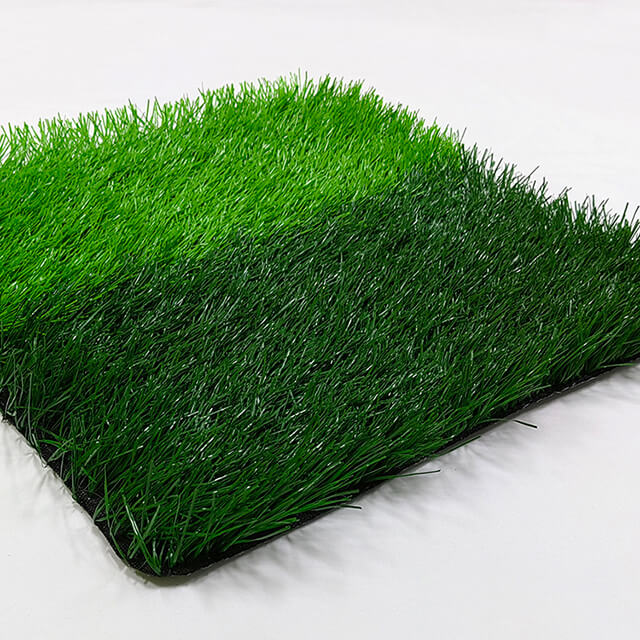
Selecting a backing material in a vacuum leads to poor project outcomes. You must match the technological profile of the backing to your specific site requirements and expected traffic levels.
Pet areas face unique chemical and drainage challenges. If a backing absorbs liquids, it will inevitably trap ammonia from pet urine. This creates severe, lingering odor problems. For dog parks and pet facilities, you should prioritize polyurethane paired with an aggressively hole-punched matrix or a fully permeable backing. PU prevents the coating from absorbing the urine, while the open drainage design flushes liquids away quickly. This combination effectively stops ammonia build-up.
Athletic fields endure severe mechanical stress. The punishing physics of cleats digging into synthetic fibers create massive rotational friction. High-impact applications, especially those requiring professional-grade football grass, demand maximum structural reinforcement. For these fields, a commercial-grade PU coating applied over a double-layered primary backing is completely non-negotiable. This heavy-duty construction prevents aggressive yarn pull-out and ensures seam integrity under heavy athletic loads.
Decorative lawns do not require athletic-grade tuft bind. You must balance your budget against desired longevity. Over-speccing a low-traffic visual lawn wastes capital. A high-quality latex coating will easily sustain standard foot traffic in a mild climate. You should reserve premium PU upgrades for commercial lawns facing intense daily pedestrian traffic or severe weather exposure.
Buyers frequently fall into a dangerous trap: assuming the material name guarantees performance. In reality, cheap PU or poorly mixed latex will fail rapidly. The chemical formulation means nothing if the manufacturer executes the application poorly.
You must rigorously evaluate the artificial turf factory quality control before placing an order. Factory execution dictates the final field performance just as much as the raw materials do.
Watch out for manufacturers cutting corners during production. You can use several criteria to verify their execution standards.
Coating Weight: Some factories skimp on the secondary coating volume to save money. A lighter coating weight directly results in a lower tuft bind. Always ask the supplier to specify the backing weight per square yard.
Oven Curing Processes: After applying the liquid coating, the factory must bake the turf in massive ovens. If they run the line too fast, the backing emerges under-cured. Under-cured latex or PU leads to catastrophic bubbling, delamination, and premature degradation on site.
Certifications & Testing: Never accept verbal promises regarding factory quality. Demand verifiable ISO certifications. Request independent SGS testing reports proving the product meets international safety and durability standards. Furthermore, ensure the warranty explicitly covers backing failures.
Even the finest materials will fail if you ignore the realities of the installation site. The backing interacts directly with the environment beneath it. You must manage several critical site variables.
The turf backing rests entirely upon the aggregate base layer. The interaction between these two elements determines the surface smoothness. If you install a rigid PU backing over a poorly compacted sub-base, the turf will not settle properly. The rigid backing requires a meticulously leveled aggregate layer to avoid visible surface wrinkling and uneven seams.
Drainage strategies must align perfectly from top to bottom. You risk severe water trapping if you pair a highly permeable backing with a slow-draining sub-base. The water will flow rapidly through the turf only to pool on top of the dense aggregate. This trapped water degrades the installation and promotes mold growth. Always ensure the aggregate grading matches the turf's drainage rate.
Heavy-duty backings require specialized installation expertise. Stiffer PU panels resist easy manipulation. Installers need specific experience handling these heavier rolls. They must utilize temperature-aware cutting techniques, as rigid materials expand and contract differently than standard latex. Seam integration also proves more challenging, demanding industrial-grade adhesives and precise joint alignment.
The "best" backing for artificial turf does not exist as a universal standard. Your optimal choice depends entirely on your specific application, local climate, and expected traffic volume. Standard residential lawns thrive on high-quality latex, while dog parks and athletic fields require the non-porous strength of polyurethane.
To protect your investment, take the following next steps:
Request physical samples of both latex and PU options to feel the rigidity and weight differences yourself.
Demand the technical data sheet (TDS) from your supplier to verify the exact tuft bind strength.
Question your vendor explicitly about their factory quality control tolerances, coating weights, and oven curing standards.
Match your final backing selection to a well-engineered sub-base to ensure flawless drainage.
A: Yes, it significantly impacts drainage. Standard backings use a hole-punched design, allowing water to drain through evenly spaced perforations. Conversely, fully permeable backings let water pass through the entire surface area. Permeable backings drain much faster but require a highly porous sub-base to prevent pooling underneath.
A: High-quality latex is structurally safe for dogs. However, latex naturally absorbs trace amounts of moisture, which can trap ammonia from pet urine and cause lingering odors over time. While PU prevents this issue entirely, you can successfully maintain a latex-backed lawn with specialized enzyme cleaners and regular rinsing.
A: A well-manufactured commercial backing typically lasts between 10 to 15 years. This timeline heavily depends on factory quality control, proper sub-base installation, and foot traffic volume. Under-cured coatings or lightweight applications will significantly reduce this expected lifespan.
A: Football players wear aggressive cleats that dig into the synthetic fibers. When players plant their feet and pivot, they generate extreme rotational traction. A high tuft bind ensures the backing securely grips every fiber, preventing the cleats from ripping the yarn directly out of the turf panel.


