
WhatsApp

close
Choose Your Site
Global
Social Media
Author: Site Editor Publish Time: 2026-04-23 Origin: Site


Selecting the right bonding agent represents a critical risk-management decision for any athletic facility. A multi-million-dollar sports field will ultimately fail if its invisible seams and bonds degrade prematurely. You cannot afford to overlook what holds your investment together. Buyers often obsess over turf face weight and yarn type during procurement. However, the Turf Adhesive Glue dictates the overall structural integrity, athlete safety, and operational lifespan under high athletic impact. The highest quality artificial grass means nothing if the seams pull apart mid-game. This guide provides a technical, bottom-of-the-funnel framework for facility managers and contractors. You will learn how to properly evaluate chemical formulations, calculate your Total Cost of Ownership (TCO), and mitigate severe installation risks. By understanding these technical variables, you can confidently build a safer, more durable playing surface for your athletes.
Performance Over Lab Specs: Real-world longevity relies on "green strength" (initial grab) and elasticity, not just static lab tensile strength.
Chemistry Matters: Polyurethane (PU) is the athletic standard; Epoxies are too rigid, and Acrylics lack outdoor weatherability.
1K vs. 2K Framework: Project scale and temperature dictate the choice between moisture-curing single-component (1K) and chemically reactive two-component (2K) formulas.
System Integration: Adhesives must be paired correctly with substrates and high-quality artificial grass accessories (like non-adhesive seam tape) to prevent joint failure.
Many installation contractors make decisions based strictly on laboratory data. They look at a bucket, see a massive tensile pull-strength number, and assume it guarantees field longevity. We must debunk this tensile strength myth immediately. Exceptionally high lab-tested pull strength becomes irrelevant if the glue turns brittle in the real world. Constant ultraviolet (UV) exposure degrades weak chemical bonds. Winter freezing also shatters rigid polymers. You need real-world weatherability, not just a high score in a climate-controlled testing facility.
You must prioritize "green strength" during your installation phase. We define green strength as the initial wet grab of the adhesive right after application. High-viscosity initial tack is mandatory for professional jobs. It serves a very specific mechanical purpose. You must combat turf "shape memory." When you unroll massive synthetic turf panels, the backing material wants to curl back up. Without aggressive green strength, the edges of the turf will lift before the glue fully cures. Strong wet grab pins those stubborn edges down permanently.
Consider the Total Cost of Ownership (TCO) implications when sourcing materials. We consider cheap adhesives to be a ticking time bomb. You might save a fraction of your budget upfront by choosing a discount bucket. However, those initial savings evaporate quickly. When cheap glue fails, you face enormous labor costs. You must hire crews to slice open the lifted seams. They must scrape away the degraded resin. You will also have to replace lost infill. Buying premium adhesive upfront acts as cheap insurance for your facility.
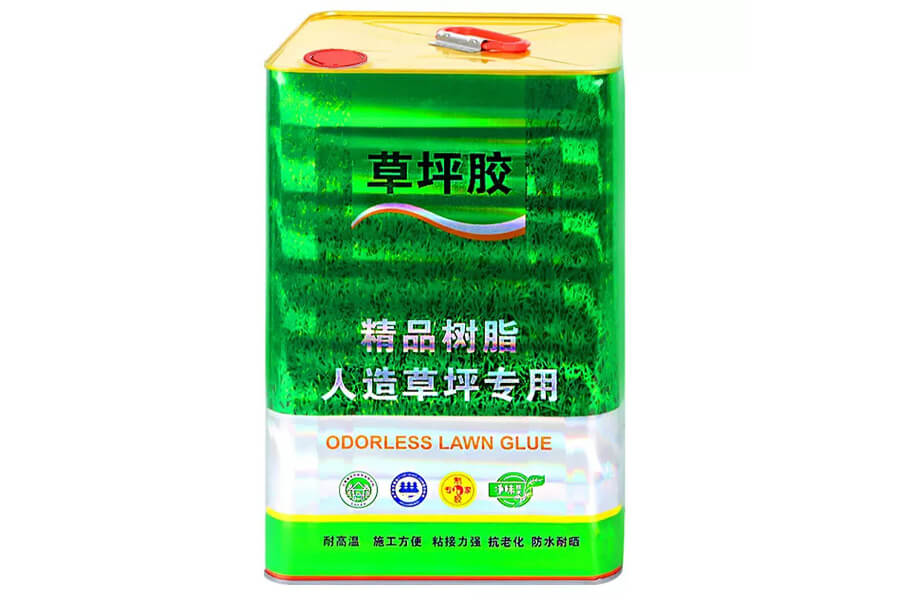
Chemistry dictates the lifespan of your installation. You must match the base chemical formulation to your specific environmental demands. Not all industrial glues belong on an athletic field.
Polyurethane (PU) adhesives serve as the absolute gold standard for sports fields. We highly recommend PU formulas because of their post-cure elastomeric properties. When polyurethane dries, it retains a distinct rubber-like flexibility. This flexibility actively absorbs heavy athletic shock. When a football player plants their cleats violently, the glued seam stretches slightly rather than breaking. It also effortlessly accommodates natural thermal expansion and contraction during seasonal weather changes.
Epoxy adhesives boast extreme hardness and fantastic chemical resistance. We acknowledge their power in industrial settings. However, you must flag the risks they pose outdoors. Rigid epoxy bonds often crack under repetitive heavy impact. A dynamic sports field generates intense shear force. Epoxies lack the necessary elasticity to survive this daily abuse. They simply snap under pressure.
Acrylic adhesives should be immediately dismissed for professional outdoor use. They rely on water-based chemistry. This makes them inherently prone to moisture degradation. They dissolve or lose structural integrity after prolonged rain exposure. You should strictly reserve acrylics for light-duty, climate-controlled indoor applications.
Chemical Baseline | Cured State | Weather Resistance | Primary Recommendation |
|---|---|---|---|
Polyurethane (PU) | Flexible / Elastomeric | Excellent (UV & Moisture resistant) | Outdoor sports fields, high-impact zones |
Epoxy | Extremely Rigid | High (Chemical resistant) | Industrial rigid flooring (Not turf) |
Acrylic | Moderately Flexible | Poor (Water soluble risk) | Indoor, climate-controlled exhibits |
Your project scale and local temperature will dictate your formula format. You must choose between single-component and two-component systems. Both utilize excellent polyurethane chemistry, but they cure differently.
One-component systems offer operational simplicity. They operate on a moisture-curing mechanism. The liquid resin actively pulls ambient humidity from the air to harden. You generally get a working window of about 30 minutes at an ideal 68°F. Higher humidity accelerates this timeline. We find 1K systems best for landscape zones and quick surface repairs. They excel for gluing custom logo inserts. Use 1K in environments where precise mixing consistency becomes a bottleneck for your crew. You simply open the bucket, trowel it out, and lay the turf.
Two-component systems require deliberate chemical activation. You must combine a base resin and a liquid hardener using an industrial drill mixer. This chemical reaction creates a much stronger, cross-linked bond. You gain an extended working window of roughly 40 to 60 minutes at 68°F. The curing process remains highly controllable and independent of ambient humidity. We strongly advise using 2K formulas for large-scale professional stadiums. They belong in high-stress athletic zones. Choose 2K for any full glue-down installation requiring maximum seam durability.
Applying the chemistry correctly requires strict methodology. A premium product will fail if applied using amateur techniques. Let us explore the primary application methods.
Hardpan substrates demand meticulous preparation. You must first fill any concrete voids or asphalt cracks with leveling compound. Ensure adequate drainage holes exist across the surface, as hard substrates trap standing water. You must scrub away oil spills or chemical contaminants. After cleaning, use a properly sized notched trowel to spread the adhesive. The notches regulate the exact volume of glue applied. Finally, you must use a heavy water roller over the installed turf. This heavy roller presses out trapped air pockets. It forces the backing matrix into the trowel ridges, ensuring uniform transfer.
Most outdoor synthetic fields utilize a permeable crushed-stone base. For these projects, you will employ seam bonding. This method requires perfect synergy between the liquid resin and premium artificial grass accessories. You lay down a 10-12 inch wide non-adhesive seam tape directly over the base. You trowel the glue onto this tape, then fold the turf panels together over it. Detail your application technique precisely. You must avoid "squeeze-out." If you apply too much glue, it pushes up into the turf fibers and ruins the visual aesthetic. Conversely, applying too little creates dry spots. Dry spots eventually lead to dangerous seam separation.
Specialty zones require specialized attention. High-wear inserts take constant localized abuse. Consider baseball halos, on-deck circles, and batter's mats. These precise custom cuts require thixotropic adhesives. A thixotropic formula is non-slumping. It stays exactly where you place it without running or spreading. This thick consistency prevents intricate turf pieces from shifting out of alignment while the base cures.
Mother Nature routinely ruins poor installation plans. You must navigate environmental constraints carefully to protect the chemical curing process.
Temperature dictates your daily "working window." Extreme heat accelerates the chemical reaction drastically. This causes a phenomenon known as "snap curing." The adhesive hardens prematurely before your crew can position the heavy turf rolls. Conversely, cold weather thickens the liquid resin. Cold glue resists the trowel. This reduces your overall coverage rates and forces the crew to work much harder to spread the material evenly.
Moisture tolerance is another critical factor. We noted earlier that 1K formulas require ambient humidity to cure. However, direct liquid water behaves entirely differently. Active rain during the initial 24-hour curing phase will destroy the chemical bond. The water dilutes the resin before it can cross-link. You must halt installation if heavy rain threatens your curing window.
Safety and regulatory compliance should also guide your product selection. Indoor applications demand strict scrutiny of Volatile Organic Compounds (VOCs). Emphasize selecting formulations classified as 100% solids with zero or low-VOC ratings. These specialized formulas protect indoor air quality. They ensure contractor safety by eliminating toxic outgassing in poorly ventilated fieldhouses.
Ignoring Substrate Temperatures: Do not measure just the air temperature. Concrete bakes in the sun and stays much hotter than the surrounding air.
Skipping the Water Roller: Walking on the seams does not generate enough uniform pressure to eliminate air voids.
Mixing Partial Batches: Never guess the ratio of a 2K system. Mix the entire pre-measured bucket to guarantee chemical stability.
Sourcing the right product means finding a highly reliable manufacturing partner. You need a vendor capable of supporting large-scale, complex projects.
Evaluate their supply chain and logistics first. Shipping heavy industrial chemicals can trigger expensive freight penalties. Look for modern, non-hazardous formulas. Products lacking a hazmat restriction reduce your shipping costs dramatically. They also simplify direct-to-site delivery logistics. You bypass the complex transport regulations associated with highly flammable solvents.
Technical support separates excellent vendors from average ones. A truly reliable Turf Adhesive Glue supplier provides extensive, transparent documentation. They must provide a comprehensive Technical Data Sheet (TDS) for every formulation. This document details the specific trowel notch sizes required. It lists exact coverage rates per square foot. It also verifies substrate compatibility. You should never guess these critical parameters while standing on a job site.
Finally, demand access to integrated systems. We recommend utilizing vendors who engineer complete bonding solutions. Seek out suppliers who also provide specialized custom artificial grass accessories. You may require heavy-duty seam tapes tailored specifically for rugby or football stresses. Sourcing your tape and your glue from the same trusted ecosystem ensures the entire bonding system remains chemically compatible.
The bonding agent acts as the invisible anchor of your athletic field's ROI. Do not compromise on this critical structural component. A flexible, high-green-strength polyurethane formula tailored to your specific site climate is strictly non-negotiable. It secures the turf, protects the athletes, and prevents budget-destroying repairs.
Take these actionable next steps to secure your installation:
Request a complete Technical Data Sheet (TDS) for all your shortlisted formulations.
Verify the hazmat shipping status and logistics timeline directly with your supplier.
Mandate a strict "dry-fit" test run with your installation crew before opening any active buckets.
A: It typically requires 24 hours of zero foot traffic to achieve a complete cure. However, the initial wet grab occurs within 30 to 60 minutes. This timeline depends heavily on ambient temperature and whether you use a 1K or 2K formula. Always consult your product's technical data sheet.
A: While possible for minor repairs or landscape edges, we strongly recommend 2K polyurethane for high-stress, full-field professional athletic applications. Two-component formulas deliver superior shear strength. They handle the violent, repetitive impacts of professional sports much better than single-component options.
A: Turf lifting is usually caused by three distinct errors. First, poor substrate prep prevents the glue from grabbing properly. Second, crews failed to use a heavy water roller to press out trapped air gaps. Finally, applying the glue outside its recommended temperature window disrupts the necessary chemical cure.


