
WhatsApp

close
Choose Your Site
Global
Social Media
Author: Site Editor Publish Time: 2025-12-04 Origin: Site


Artificial grass has become a popular choice for homes, sports fields, and commercial spaces, but many people still wonder how artificial grass is made and what goes into the artificial grass manufacturing process. In this guide, we break down each step—from raw materials to tufting and backing—so you can understand what makes high-quality synthetic turf last.
Artificial grass—often called synthetic turf—is a man-made surface designed to look and feel like natural grass. It uses engineered fibers that stand upright, stay green all year, and handle heavy foot traffic. Modern turf solves problems real grass struggles with: water use, inconsistent growth, mud, and constant maintenance. Because of this, it has become a common choice in homes, sports fields, playgrounds, and commercial landscapes.
High-quality manufacturing matters because small differences in each production step change how the turf performs. Yarn purity affects color stability and UV resistance. Poor polymer blends fade early or become brittle. Weak tufting creates loose fibers that pull out under foot pressure. Backing quality decides drainage speed and long-term dimensional stability. A well-made product keeps its shape, stays soft, and drains quickly after rain. It also protects players on sports fields by offering consistent traction and reducing the risk of slips or uneven footing.
Artificial grass is made from several key components that work together:
| Component | Function |
|---|---|
| Synthetic Yarn | Forms the visible “grass blades”; determines softness, strength, UV stability |
| Primary Backing | Woven base cloth that holds the stitched fibers in place |
| Secondary Backing | Latex or PU coating that locks fibers securely into the backing |
Manufacturers combine these materials to produce turf for many industries. Residential landscapes use soft, natural-looking yarns. Playgrounds prefer thick, cushioned turf paired with shockpads. Sports fields rely on strong monofilament fibers shaped to resist wear. Commercial spaces choose durable, UV-stable systems for long service life. Pet facilities need fast-draining backing that reduces odor and bacteria buildup.
Artificial grass comes from engineered polymers. These materials melt, turn into yarn, and form the visible “blades” you see on a finished turf roll. Each polymer offers a unique mix of softness, strength, and durability.
Polyethylene (PE) – The most widely used modern material. It produces soft, flexible yarn that feels comfortable underfoot.
Polypropylene (PP) – Stiffer and less expensive. It works well for thatch layers or short, dense sports turf.
Nylon (PA) – Extremely strong but too abrasive for most landscape use. It appears mainly in specialized applications where high wear resistance matters.
The blend chosen determines how the turf performs once installed.
PE dominates modern turf manufacturing. Consumers want grass that looks natural, feels soft, and lasts under sunlight for many years. PE offers all of these advantages:
Softness – It bends easily and feels gentle on feet or hands.
Natural appearance – It reflects light in a way closer to real grass.
High UV-resistance – It handles long hours of sunlight without cracking.
Versatility – It suits both sports fields and residential lawns.
PE gives manufacturers more control over yarn shape, color, and recovery, so it appears in premium products.
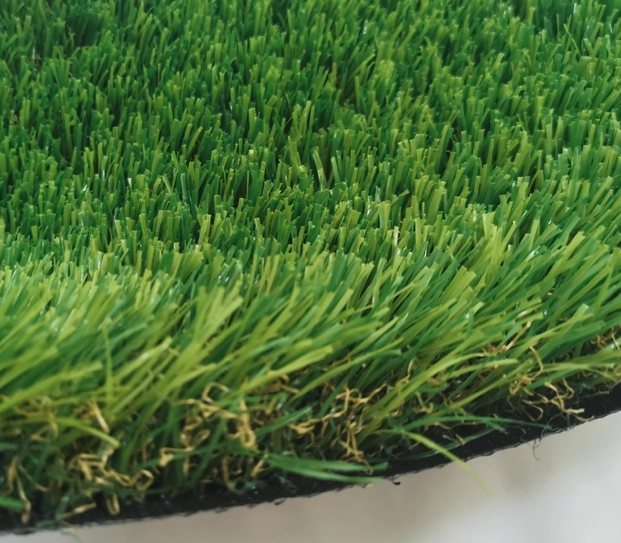
Yarn extrusion is the first major step in creating artificial grass fibers. The process melts polymer pellets, pushes the molten material through narrow dies, and forms long, consistent strands. As it leaves the extruder, the material cools and becomes the basic structure for each “grass blade.”
Extrusion matters because it controls strength, UV stability, and overall performance. Poorly extruded yarn may weaken early or fade under sunlight, while well-processed yarn stays flexible and durable for years.
Manufacturers use two main types of yarn: fibrillated and monofilament. They look different, behave differently, and serve different purposes.
| Yarn Type | Strength | Appearance | Typical Use |
|---|---|---|---|
| Fibrillated | Moderate | Less natural | Hockey, older sports turf, thatch layers |
| Monofilament | High | Very natural | Football, soccer, landscaping |
Monofilament yarns outperform fibrillated yarn in most modern applications, especially when shaped for better recovery.
After extrusion, the fresh yarn needs cooling and tension to develop strength. We guide the strands through long water baths to drop their temperature fast. From there, tension rollers stretch the fibers, align the molecules, and increase durability.
Water cooling baths – Stabilize shape.
Stretching zones – Improve tensile strength.
Tension rollers – Maintain consistent thickness.
This step gives each blade the firmness needed for long-term performance.
Pile height is the length of the grass blade, usually between 9 mm and 70 mm. Shorter heights appear in hockey turf, while thicker blades appear in soccer or landscaping products.
Stitch rate measures how many stitches the machine creates per 10 cm or per meter. It directly affects density.
Higher density = fuller look, better durability
Lower density = lighter, more flexible, lower cost
Manufacturers balance pile height and stitch rate to meet performance needs for each application.
The tufting process moves in a steady, rhythmic sequence, and every action contributes to the structure and stability of the finished turf. A tufting machine works at high speed, but the flow must stay controlled so the grass fibers line up cleanly and evenly across the entire roll.
How Tufting Works:
Yarn fed from creel → needles
The creel delivers yarn from hundreds of spools, keeping tension stable as each strand enters its assigned needle channel.
Needles punch yarn through backing cloth
Thousands of needle strokes per minute push the yarn into the primary backing, forming tight, precise rows.
Knives cut loops to predetermined height
Sharp blades cut each loop to create upright blades at the exact pile height set for the product.
Machine maintains consistent speed
Smooth, constant movement prevents gaps, uneven stitches, or visual lines in the turf.
QC inspections
Technicians walk alongside the machine, checking for broken fibers, misalignment, color shifts, or any irregularities that appear while tufting.
This controlled sequence ensures each roll of turf has uniform density, clean rows, and long-term stability before moving to the backing stage.
| Step | Description |
|---|---|
| 1. Yarn fed from creel → needles | Creel system delivers yarn into each needle channel. |
| 2. Needles punch through backing | Needles move rapidly to push yarn into the backing cloth. |
| 3. Knives cut loops to height | Knives trim yarn to the set pile height for upright fibers. |
| 4. Machine runs at constant speed | Ensures stable stitch spacing across the entire roll. |
| 5. QC inspections | Technicians check for broken fibers, missed stitches, or uneven rows. |
This cycle repeats rapidly until a complete roll of turf forms.
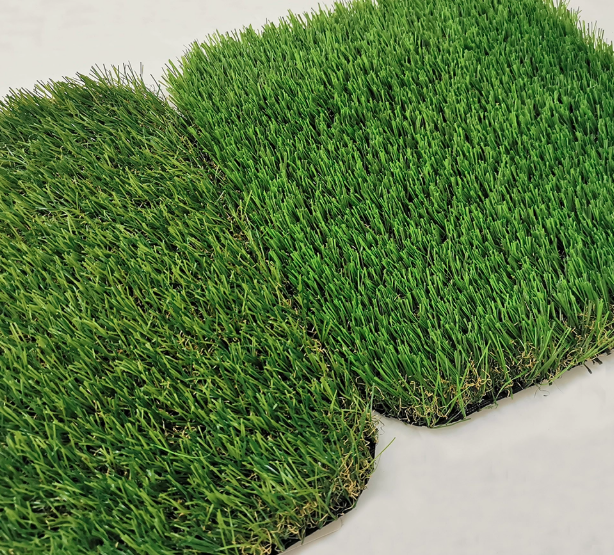
Artificial grass is created through a multi-stage manufacturing process. It begins with melting polymers, extruding yarn, cooling and stretching fibers, tufting those fibers into a backing, applying a latex or PU coating, curing the turf in an oven, and finishing with perforation and rolling. Each step influences durability, UV resistance, and overall appearance.
Most turf products use polyethylene (PE), polypropylene (PP), or nylon (PA). PE is the most popular because it’s soft, UV-resistant, and natural looking. PP appears in thatch layers or some sports turf. Nylon is used in high-wear areas but feels rough underfoot.
Fibrillated yarn starts as a flat tape that splits into a net-like structure. Monofilament yarn forms individual “grass blades” straight from the extruder. Monofilament yarn looks more realistic and lasts longer, so manufacturers use it in modern sports fields and landscaping turf.
Good manufacturing prevents fading, fiber shedding, and drainage issues. Quality yarn stays soft and UV-stable. Proper tufting keeps blades secure. Strong backing improves lifespan and field safety. Poor manufacturing leads to early wear or uneven surfaces.
Premium turf includes UV inhibitors and stabilizers that protect fibers from sun exposure. Low-quality products may fade or become brittle sooner.
As you’ve seen, creating high-quality artificial grass involves far more than melting plastic and stitching fibers. Every stage—from polymer selection to yarn extrusion, tufting, and backing—shapes how well the turf performs in real environments. Understanding these steps helps you choose products that stay bright, durable, and safe for years.
If you want turf backed by reliable manufacturing and strict quality control, Qingdao XiHY Artificial Grass Company delivers professional artificial grass solutions for landscaping, sports, and commercial projects. Reach out anytime—we’re here to help you build a surface that looks good and lasts long.


